Chapter 1: Introduction to Exercise Rehabilitation
Learning Objectives
By the end of this chapter, you will be able to:
- Define exercise rehabilitation and differentiate it from general fitness training.
- Identify the physiological, psychological, and functional benefits of exercise rehabilitation.
- Describe the short-term and long-term goals of an exercise rehabilitation program.
Introduction
Exercise rehabilitation is a cornerstone of modern physiotherapy practice. It represents a systematic, evidence-based approach to restoring function, reducing disability, and preventing recurrence of injury or disease. Unlike general fitness programs, exercise rehabilitation is tailored to each individual’s specific impairments, activity limitations, and participation restrictions, as defined by the International Classification of Functioning, Disability and Health (ICF) model. This chapter lays the foundation for the entire course by defining the concept, emphasizing its importance, and outlining the overarching goals that guide clinical decision-making.
Definition of Exercise Rehabilitation
Exercise rehabilitation is the therapeutic use of physical activity and exercise to restore or improve physiological, biomechanical, and functional capacity following injury, surgery, or disease. It is a structured process that includes assessment, prescription, progression, and reassessment. The American College of Sports Medicine (ACSM) defines therapeutic exercise as “a planned, structured, and repetitive physical activity performed with the goal of improving or maintaining physical fitness or health.” In the rehabilitation context, the exercise prescription is individualized, often incorporating specific parameters such as frequency, intensity, time, and type (FITT principle) to target deficits in strength, endurance, flexibility, balance, coordination, or neuromuscular control.
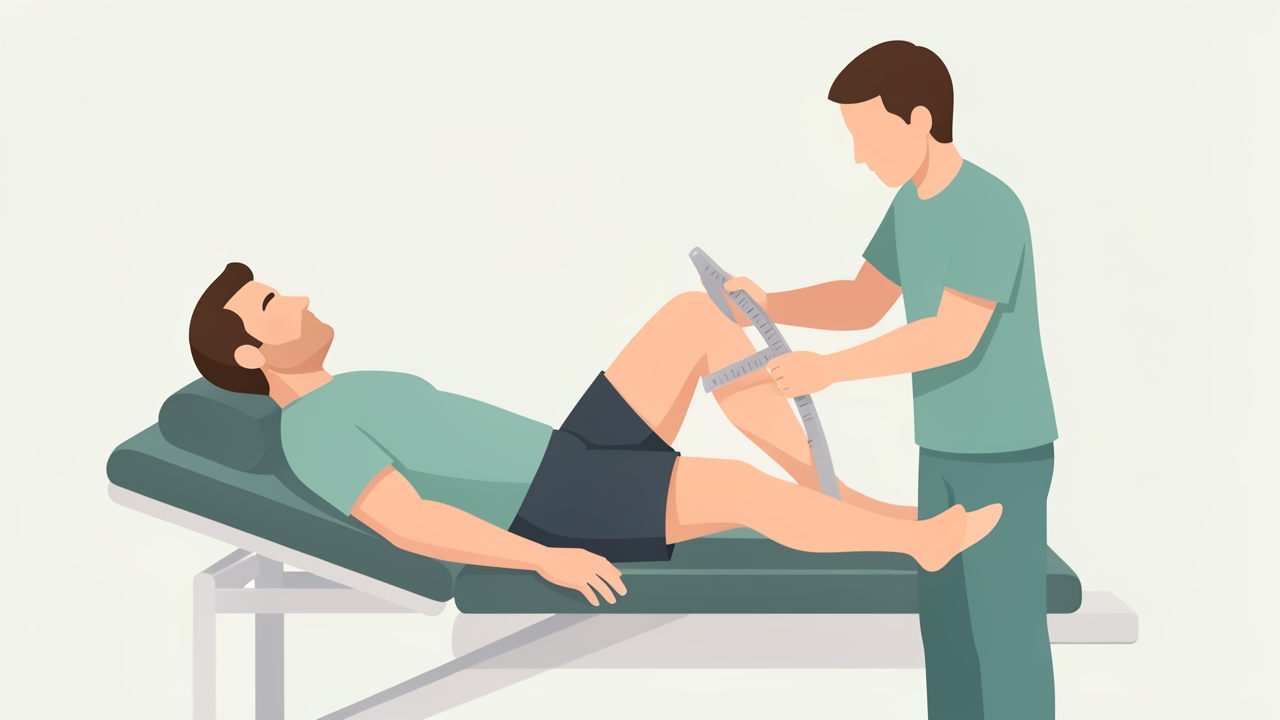
Progression rests on objective measures: pain on the VAS (0–10), goniometric range of motion, manual muscle testing (grades 0–5) and functional tests.
Key distinctions from general fitness include:
- Individualized progression: Based on objective measures like pain levels (Visual Analog Scale, VAS 0–10), range of motion (ROM) goniometry, manual muscle testing (MMT grades 0–5), and functional tests (e.g., Timed Up and Go).
- Pathology-specific protocols: For example, after anterior cruciate ligament reconstruction, early-phase rehabilitation emphasizes quadriceps activation and full knee extension (0°) within the first week, whereas later phases focus on plyometric training.
- Outcome-oriented milestones: Discharge criteria often require achieving ≥80% limb symmetry index (LSI) on hop tests for return to sport.
Importance of Exercise Rehabilitation
Exercise rehabilitation is vital for several reasons, spanning physiological, psychological, and functional domains.
Physiological Benefits
- Muscle strength and endurance: Immobilization can cause up to 1–3% loss of muscle strength per day, with significant atrophy evident after just two weeks. Resistance training at 60–80% of 1-repetition maximum (1RM) can reverse this loss and restore cross-sectional area.
- Joint ROM: Normal knee flexion is 0–135°; following total knee arthroplasty, early passive ROM (continuous passive motion) and active-assisted exercises target achieving 90° flexion by week 2 and full ROM by week 6.
- Proprioception and neuromuscular control: Deficits in joint position sense (e.g., threshold to detection of passive motion) are common after ligament injuries. Training progresses from static (single-leg stance on firm surface) to dynamic (unstable surfaces, perturbation) to restore sensorimotor function.
Psychological Benefits
- Pain modulation: Graded exercise reduces central sensitization and fear-avoidance beliefs. Using the Pain Monitoring Model, patients are encouraged to exercise at levels that do not increase pain beyond 2–3/10 on VAS.
- Self-efficacy: Successful completion of progressive tasks (e.g., returning to walking without aids) improves confidence and adherence.
Functional Benefits
- Activities of daily living (ADL): For example, stair climbing requires at least 60° knee flexion and 80% quadriceps strength. Rehab targets these thresholds.
- Return to work/sport: Specific criteria include strength within 90% of the uninjured side, full ROM, and no pain. For athletes, sport-specific drills (e.g., cutting, jumping) are introduced only after passing functional tests.
Goals of Exercise Rehabilitation
Goals are categorized as short-term (phase-specific) and long-term (outcome-based) and should be SMART (Specific, Measurable, Achievable, Relevant, Time-bound).
Short-Term Goals (First 2–6 Weeks)
- Pain and swelling control: Reduce VAS from 6/10 at rest to 2/10 during activity within 2 weeks.
- Restore joint ROM: For shoulder stiffness, achieve 120° forward flexion and 90° abduction by week 4.
- Activate inhibited muscles: Quadriceps setting exercises (isometric contractions) aim for a palpable contraction within 48 hours post-surgery.
- Maintain cardiovascular fitness: Use upper body ergometry (arm crank) at 40–60% heart rate reserve (HRR) when lower limb is immobilized.
Intermediate Goals (6–12 Weeks)
- Improve strength: Progress from isometrics to isotonic exercises at 50–70% 1RM, 2–3 sets of 8–12 reps, achieving MMT grade 4/5.
- Enhance neuromuscular control: Balance training progresses from double-leg to single-leg stance on foam, aiming for 30-second hold without loss of balance.
- Normalize gait: After ankle sprain, restore heel-toe gait pattern with step length symmetry (within 5 cm of contralateral).
Long-Term Goals (12+ Weeks)
- Achieve full function: Return to pre-injury activity level (e.g., jogging at 6–8 weeks after mild knee injury, sprinting at 12–16 weeks).
- Prevent recurrence: Eccentric hamstring exercises (Nordic curls) reduce hamstring strain recurrence by 65%.
- Optimize quality of life: Using the SF-36 or Lower Extremity Functional Scale (LEFS), a minimal clinically important difference (MCID) of 9 points indicates meaningful improvement.
Key Principles of Exercise Prescription in Rehabilitation
To achieve the above goals, rehabilitation follows foundational principles:
- Specificity: Training adaptations are specific to muscle groups, contraction type, and joint angle. For example, after rotator cuff repair, exercises are performed in the scapular plane (scaption) to avoid impingement.
- Overload: To stimulate adaptation, the exercise load must exceed the current capacity. A common progression is increasing resistance by 5–10% when the patient can complete two additional reps beyond the target.
- Progression: Phases typically transition from protected (submaximal, low load) to functional (high load, sport-specific). An example: after lateral ankle sprain, progress from non-weight-bearing (phase I, week 1) to partial weight-bearing with brace (phase II, weeks 2–3) to full weight-bearing and agility drills (phase III, weeks 4–6).
- Reversibility: “Use it or lose it.” A two-week break can reduce strength gains by 30–50%, emphasizing the importance of adherence.
The Role of the Rehabilitation Team
Exercise rehabilitation is delivered by a multidisciplinary team, with the physiotherapist as the primary prescriber and the physiotherapy technician supporting implementation. The technician monitors vital signs (heart rate, blood pressure), sets up equipment, and ensures correct technique. Normal resting heart rate is 60–100 bpm; exercise heart rate targets are calculated using Karvonen formula: [(HRmax – HRrest) × % intensity] + HRrest. For moderate-intensity rehab, aim for 40–60% heart rate reserve (HRR). Blood pressure should not exceed 180/110 mmHg during exercise; if it does, the session is terminated.
Summary
Exercise rehabilitation is a specialized, goal-driven process that restores function and reduces disability. Its importance spans physiological healing, psychological well-being, and functional independence. The goals progress from pain control and ROM to strength, balance, and return to activity. Understanding these core concepts is essential for designing safe and effective programs. The remaining chapters will delve into specific conditions, exercise modalities, and progression frameworks.
References
- Kisner, C., & Colby, L. A. (2017). Therapeutic Exercise: Foundations and Techniques (7th ed.). F.A. Davis Company.
- American College of Sports Medicine. (2018). ACSM’s Guidelines for Exercise Testing and Prescription (10th ed.). Wolters Kluwer.
- O’Sullivan, S. B., Schmitz, T. J., & Fulk, G. D. (2019). Physical Rehabilitation (7th ed.). F.A. Davis Company.
- Dvir, Z. (2004). Isokinetics: Muscle Testing, Interpretation, and Clinical Applications (2nd ed.). Churchill Livingstone.
- Heiderscheit, B. C., Sherry, M. A., Silder, A., Chumanov, E. S., & Thelen, D. G. (2010). Hamstring strain injuries: recommendations for diagnosis, rehabilitation, and injury prevention. Journal of Orthopaedic & Sports Physical Therapy, 40(2), 67–81.
- Kline, P. W., Morgan, K. D., Johnson, D. L., Ireland, M. L., & Noehren, B. (2015). Impaired quadriceps rate of torque development and knee mechanics after anterior cruciate ligament reconstruction with patellar tendon autograft. American Journal of Sports Medicine, 43(8), 1921–1927.
- Bahr, R., & Krosshaug, T. (2005). Understanding injury mechanisms: a key component of preventing injuries in sport. British Journal of Sports Medicine, 39(6), 324–329.