PhysioAI — Think Like a Clinician

Ask a question. Get the evidence, screened and cited.

PhysioAI searches the research library and five live scholarly databases, screens every paper against your question, ranks what’s left by strength of evidence — and writes you a cited summary, literature review, clinical answer or evidence table.

Your first review is free — reports and follow-up questions included.

No phone handy? Use it in your browser at app.physioai.in

5

live databases + the PhysioAI library

90

papers screened per review, at most

6

ways to use the evidence

100%

of claims carry a citation

See it in action.

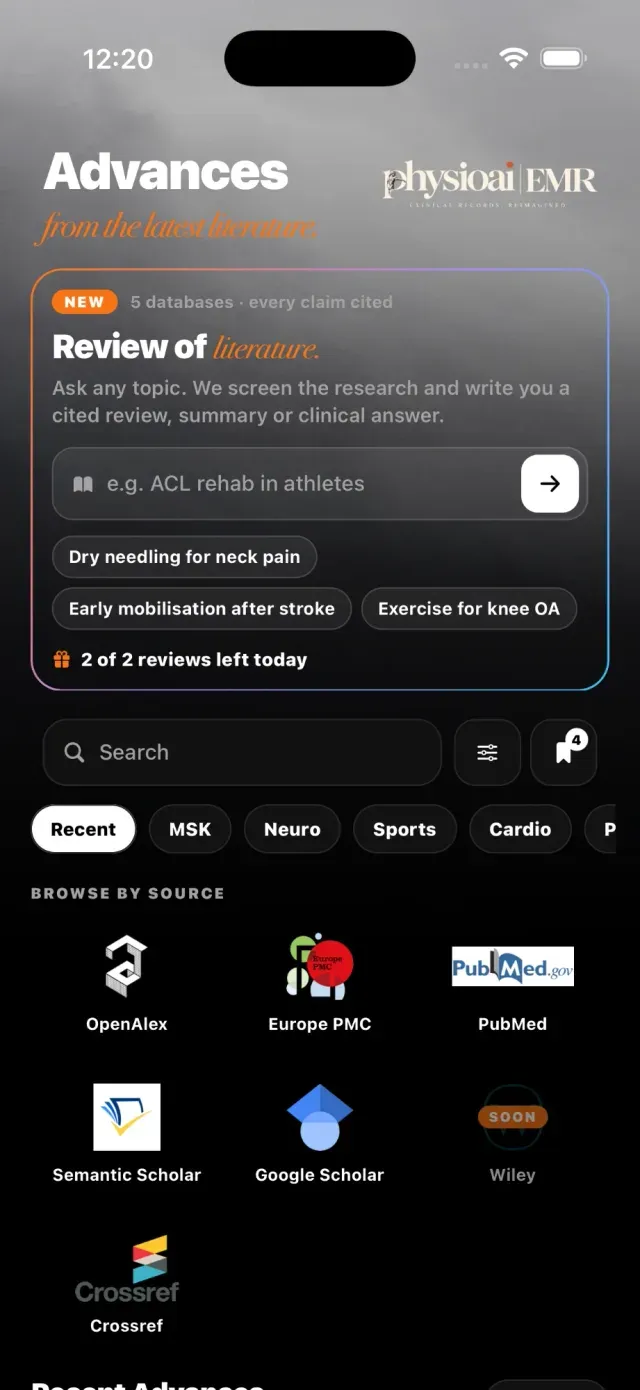
Advances opens with Review of Literature on top
01

Advances opens with Review of Literature on top

The research feed you already use, with Review of Literature waiting at the very top. Type a topic and tap the arrow — the review starts right away.

  1. 01Tap an example topic if you are not sure what to ask.
  2. 02See how many reviews you have left, right on the card.
  3. 03Below it: search, filters, your saved papers, specialty pills and the databases behind the feed.
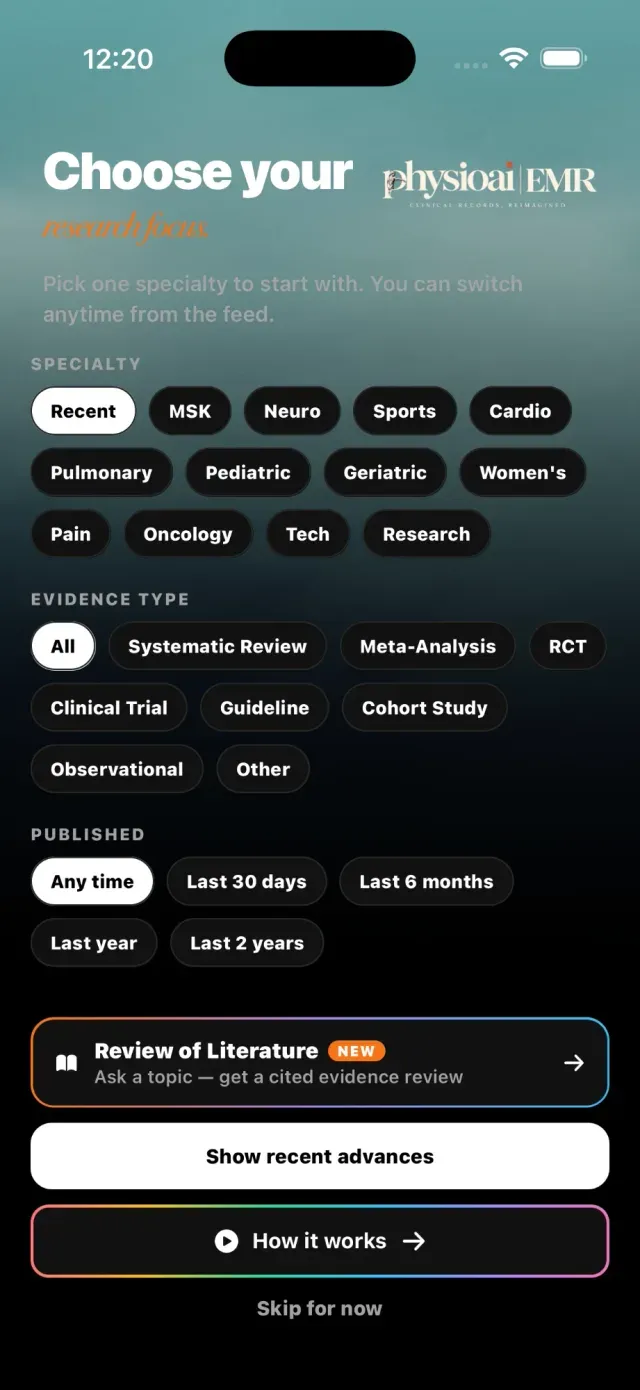
Choose your research focus
02

Choose your research focus

Each time you open Advances you can shape the feed before you read: a specialty, the kind of evidence you trust, and how recent it should be.

  1. 01Recent plus 12 specialties, from MSK and Neuro to Oncology and Tech.
  2. 02Evidence type: systematic reviews, meta-analyses, RCTs, guidelines and more.
  3. 03Or skip the feed entirely and start a Review of Literature from here.
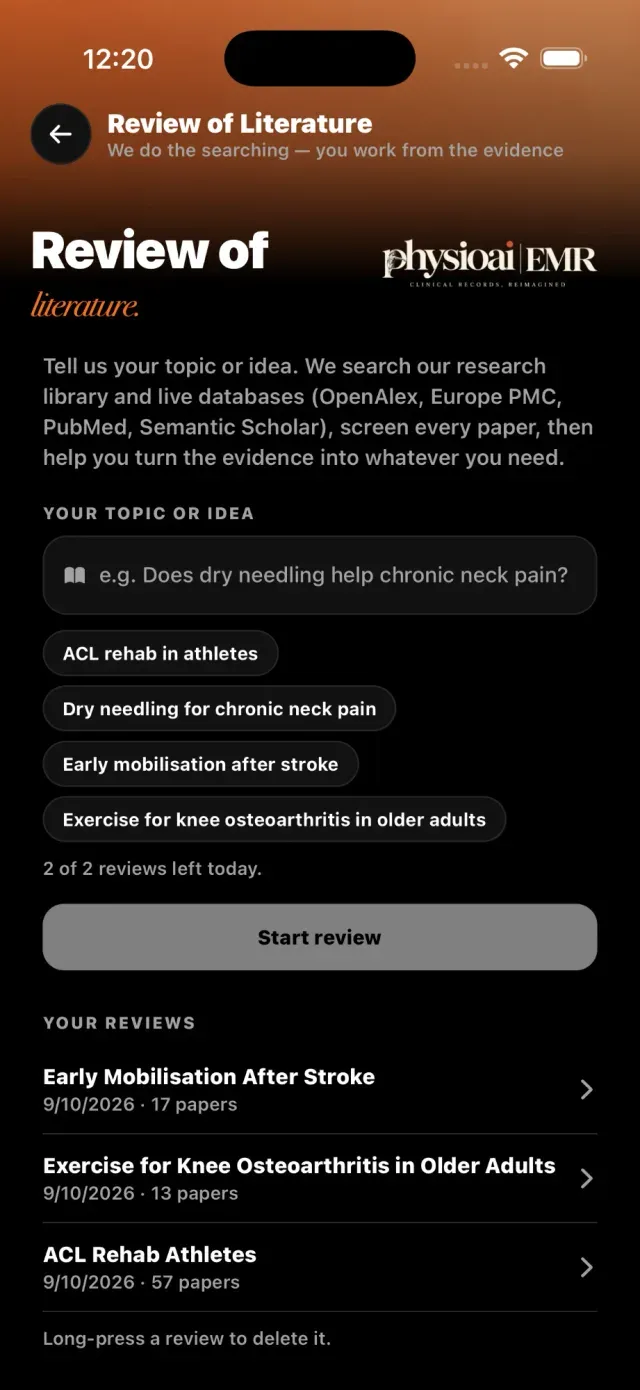
Start a review — your past reviews stay saved
03

Start a review — your past reviews stay saved

Write your topic or clinical question in plain words. Every review you run is saved below, so you can come back to it any time.

  1. 01Example topics to get you started in one tap.
  2. 02Your remaining reviews for the day, shown before you start.
  3. 03Each saved review shows its title, date and how many papers it found.
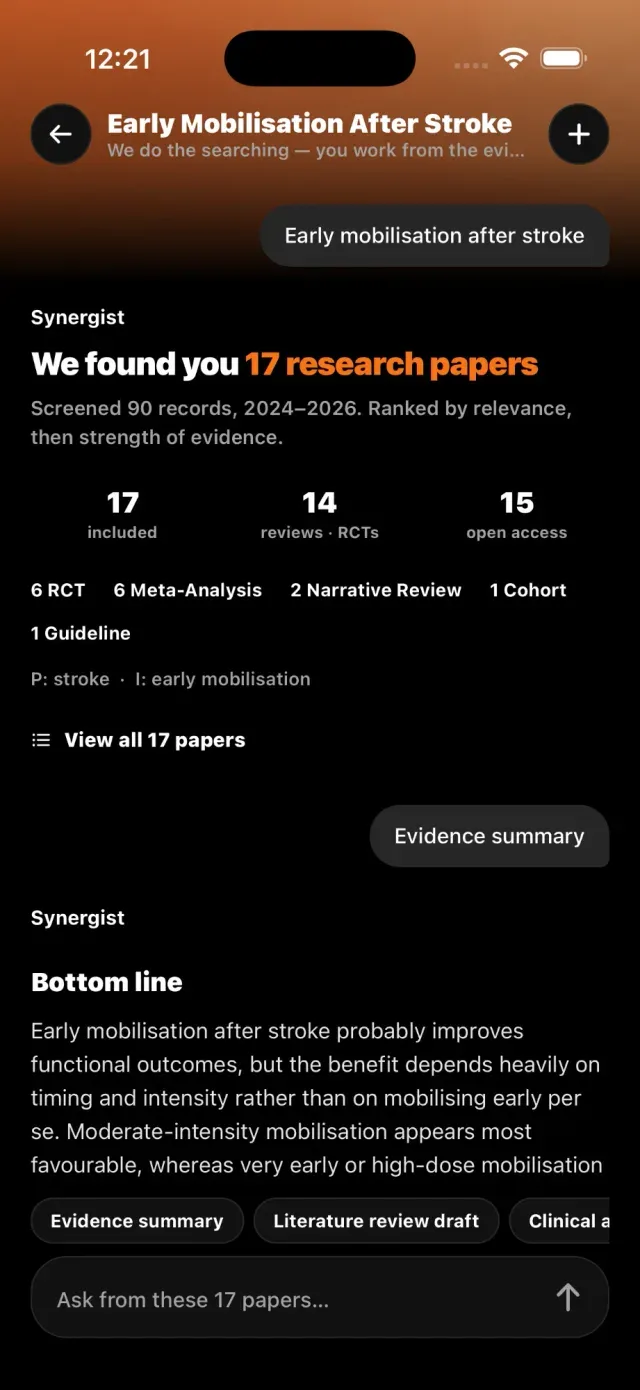
“We found you 17 research papers”
04

“We found you 17 research papers”

After searching and screening, you see exactly what made the cut — before any writing happens.

  1. 0190 records screened, 17 included — 14 of them reviews or RCTs, 15 open access.
  2. 02A breakdown by study design and the PICO used for the search.
  3. 03View all papers, then choose what you want: a summary, review draft, clinical answer, table or gaps.
A report where every claim is cited
05

A report where every claim is cited

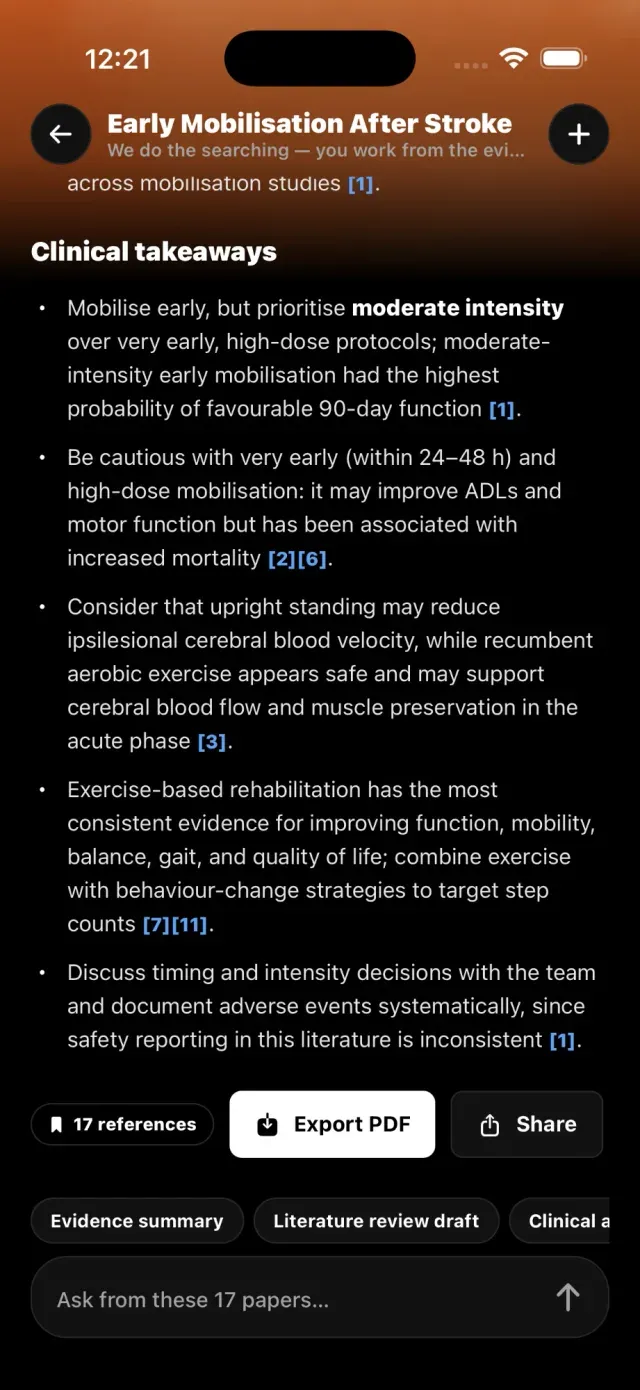
Synergist writes from the included papers only. Every blue number is a citation — tap it and the paper opens.

  1. 01Clinical takeaways written for physiotherapists, each one backed by a study.
  2. 02Export a branded PDF or share it, with all references attached.
  3. 03Keep asking: “Ask from these 17 papers…” stays grounded in the same evidence.

Searches where the evidence lives

Five live scholarly databases, searched together and merged — plus a physiotherapy research library that grows with every search.

PubMed logoPubMed
Europe PMC logoEurope PMC
OpenAlex logoOpenAlex
Semantic Scholar logoSemantic Scholar
Crossref logoCrossref

Papers from journals like

British Journal of Sports Medicine
BMJ
Cochrane
JAMA
Nature
PLOS
Frontiers
Springer
Elsevier
Wiley
SAGE
Taylor & Francis
BMC
JMIR
Archives of PM&R
IJSPT

Discover. Synthesise. Understand.

Discover

Advances

A live physiotherapy research feed. Browse by specialty, filter by evidence, save what matters.

Synthesise

Review of Literature

Ask a question. Every relevant paper found, screened, ranked — and turned into a cited report.

Understand

Synergist

Ask what it means for practice. Follow-up answers stay grounded in the papers.

We do the searching. You work from the evidence.

The part of research that takes days — finding papers, reading abstracts, deciding what counts, writing it up with references — done for you in about a minute.

From hundreds of records to the few that matter

Most of what a search returns isn’t about your question. Review of Literature reads every candidate, keeps what is relevant, and shows you exactly what made the cut — and why.

How a review works

Follow the arrows — this is exactly what happens in the app, in order.

01

Ask in plain words

Type a topic, an idea or a clinical question — the way you would ask a senior colleague.

  1. 01“Does dry needling help chronic neck pain?” or simply “ACL rehab in athletes”.
  2. 02Tap an example if you are not sure where to start.
  3. 03If the topic is too broad, Synergist asks one quick question with tap-to-answer options — or you skip it.
02

We turn it into a research question

Your words become a structured, answerable question — the same way researchers frame a review.

  1. 01PICO: Population · Intervention · Comparison · Outcome.
  2. 02Synonyms and clinical terms, so relevant papers are not missed because they used different words.
  3. 03A sensible date window covering the last decade of evidence by default.
“Does exercise help older people with knee arthritis?”
PPopulation

older adults with knee osteoarthritis

IIntervention

exercise therapy

CComparison

usual care / no exercise

OOutcome

pain, physical function

03

We search where the evidence lives

The PhysioAI research library plus five live scholarly databases, searched together. You watch it happen, source by source.

  1. 01PubMed, Europe PMC, OpenAlex, Semantic Scholar and Crossref.
  2. 02Live progress with result counts from every database.
  3. 03Duplicates across databases are merged automatically.
PhysioAI libraryPubMedEurope PMCOpenAlexSemantic ScholarCrossref
04

Every paper is screened

AI reads the title and abstract of up to 90 candidate papers and checks each one against your question.

  1. 01Relevance to your question — not just keyword matches.
  2. 02Study design detected from the abstract: meta-analysis, systematic review, RCT, cohort and more.
  3. 03Sample size where the abstract reports it, and a one-line reason for every include or exclude.
Included

RCT · n=212

“Directly compares exercise vs. usual care for pain”

Excluded

Cohort

“Surgical outcomes, not exercise therapy”

05

“We found you 17 research papers”

You see exactly what made the cut — ranked by relevance, then strength of evidence.

  1. 01Papers screened vs. included, the year range, and how many are reviews, RCTs or open access.
  2. 02A breakdown by study design and the PICO used.
  3. 03The full ranked list — including what was excluded, and why.
06

Tell us your goal. Get a cited report.

Pick what you need and Synergist writes it from the included papers only — every claim cited.

  1. 01Evidence summary, literature review draft, clinical answer, evidence table or research gaps — or describe your own goal.
  2. 02Tap any citation to open that exact paper.
  3. 03Keep asking follow-up questions — answers stay grounded in the same papers.

The strongest evidence rises first.

Papers are ordered by how well they answer your question, then by the strength of their design. You see at a glance how many meta-analyses, systematic reviews and trials support an answer.

“What do you want to do with them?”

Same screened papers, six ways to use them. Run more than one on the same review.

Evidence summary

When you need the answer fast

  • Bottom line
  • What the evidence shows, by theme
  • Strength of evidence: High · Moderate · Low · Very low
  • Gaps and clinical takeaways

Literature review draft

Assignments and dissertations

  • Introduction
  • Methods — an honest description of the search
  • Thematic findings
  • Discussion, limitations, conclusion

Clinical answer

“Should I do this for my patient?”

  • A 1–2 line answer
  • How confident you can be
  • Supporting evidence
  • Parameters — only when the studies report them

Evidence table

Study-by-study, at a glance

  • Author, year, design, sample size
  • Population and intervention vs. comparator
  • Outcomes and key finding
  • Direction of effect and limitations

Find research gaps

Choosing a thesis topic

  • What is well established
  • What is under-studied
  • Methodological weaknesses
  • 5 thesis-ready questions with PICO

Your own goal

Anything else

  • “A 5-minute class presentation”
  • “Patient handout in simple words”
  • “Compare these two treatments”
  • Grounded in the same papers

Every claim, cited. Tap to check it.

Answers are written only from the included papers. Each statement carries a numbered citation — tap it and the exact paper opens, with why it was included, its abstract, and a link to the full paper.

  1. 01Follow-up questions stay grounded in the same papers.
  2. 02If the papers don’t cover it, Synergist says so — and suggests what kind of study would.
  3. 03Save any paper to your Advances reading list in one tap.

A branded PDF, ready to submit.

  • Evidence snapshot. Papers screened and included, reviews and RCTs, open access, year range and PICO — on page one.
  • Evidence at a glance. Charts for study designs, publication timeline, what the studies found and study sizes.
  • Clickable citations. Every [n] in the text points to its reference, and every reference carries a DOI link.
  • Included studies table. Author, year, design and sample size for every included paper.
  • Prepared for you. Your name, the date, page numbers and a clean file name.
PhysioAI

Exercise for Knee Osteoarthritis in Older Adults

Review of Literature · Prepared for Dr. A. Deshpande

90
screened
13
included
10
reviews·RCTs
10
open access
2016–26
years

Evidence by study design

References

[1]
[2]
[3]
PhysioAI | physioai.in · Page 1 of 4

Built to be trusted.

Grounded in real papers

Answers come only from the papers that were found and screened. If they don’t cover something, Synergist says so.

Every claim cited

Each statement carries a numbered citation. Tap it and the exact paper opens — authors, journal, DOI and abstract.

No invented numbers

Sample sizes and effect sizes come from the abstracts. Anything not reported is left blank — never guessed.

Ranked by evidence, not by recency

Meta-analyses and systematic reviews rise first, then guidelines and RCTs. A new paper never outranks a landmark trial just for being new.

Honest when evidence is thin

When few papers answer the exact question, the results say so — and closely related papers are clearly flagged.

Traceable to the source

Every paper links to its original publication. Open access papers open in full.

Advances from the latest literature.

Physiotherapy research in one feed — discover papers, inspect the evidence, keep a reading list, and ask Synergist what it means for practice.

A live research feed

Physiotherapy research in one feed, newest arrivals first. A NEW badge marks anything that arrived in the last three days.

  • Recent plus 12 specialties: MSK, Neuro, Sports, Cardio, Pulmonary, Pediatric, Geriatric, Women’s, Pain, Oncology, Tech, Research
  • Read time and evidence type on every card
  • 30+ journal marks so the feed feels like a real library

Search, then go live

Instant search across titles, abstracts, journals, keywords and authors — and one tap to search live databases when the library is thin.

  • Results merged and de-duplicated automatically
  • Every live result is added to the library for the next reader
  • Or turn any search into a full Review of Literature

Refine the evidence

Narrow the feed to the kind of evidence you actually need.

  • Published: last 30 days to last 2 years
  • Evidence type: systematic review, meta-analysis, RCT, guideline, cohort and more
  • Open access only, and filter by source

Read with orientation

Each paper opens into a clean detail view before you go to the publisher.

  • Structured abstract split into Background, Methods, Results and Conclusions
  • A short AI summary, grounded in the abstract
  • Provenance on every paper: source, DOI or PMID

Keep what matters

Save papers to a private reading list for coursework, revision or a dissertation — and come back without repeating your search.

  • One-tap save from the feed or the paper
  • Saved view with a count badge
  • Saved papers from reviews land here too

Analyse with Synergist

Send any paper to Synergist and ask what it means for physiotherapy practice — written for physiotherapists.

  • Discovery in Advances, understanding in Synergist
  • Explains designs, outcome measures and limitations
  • A learning aid — always verify against the original

Who it’s for

01

Students

Assignment due? A cited literature review draft and an evidence table from real papers — exported as a branded PDF.

02

Dissertation & thesis

“Find research gaps” gives you five thesis-ready questions with PICO, built from what current evidence is missing.

03

Interns & clinicians

“Clinical answer” tells you what the evidence supports, how confident you can be, and the parameters — only when studies report them.

04

Educators

Evidence tables and summaries for teaching in minutes, with references your students can open.

Start free. Go further with Praxis.

FeatureFreePraxis
Advances feed and library search✓✓
SpecialtiesRecent + 1All 12
Refine filters1 at a timeAll, combined
Saved papers3Unlimited
AI summariesPreviewFull
Live database search—✓
Analyse with Synergist—✓
Review of Literature1 review, free2 new reviews every day
Reports, citations and follow-up questionsIncluded in your reviewIncluded in every review
Branded PDF export✓✓

Reopening saved reviews and asking follow-up questions never uses up a review.

Questions, answered

Your first review is on us.

Open PhysioAI on your phone or at app.physioai.in, go to Advances, type your topic and tap the arrow. Reports, citations and follow-up questions included.

Review of Literature is an AI-assisted educational research tool. It is not a substitute for a systematic review or for clinical judgment. Always verify key findings against the original papers.