Upper Body & Neck Range of Motion Assessment

Master Neck Mobility Assessment Techniques

Beginner · 12 chapters · 144 MCQs · 144 flashcards · Audiobook · Illustrated

Learn to accurately measure and evaluate neck range of motion for clinical assessment. This course covers key techniques for assessing cervical spine mobility, identifying limitations, and documenting findings for effective treatment planning.

What you'll learn

  1. Chapter 1: Introduction to Upper Body and Neck Range of Motion Assessment

    The assessment of ROM is essential in healthcare, as it provides valuable information about the patient's functional ability and potential limitations.

  2. Chapter 2: Anatomy and Biomechanics of the Upper Body and Neck

    The anatomical structures of the upper body and neck include the cervical spine, thoracic spine, shoulder girdle, and upper limb. The cervical spine is composed of seven vertebrae, which provide support and flexibility to the neck.

  3. Chapter 3: Patient Interview and History Taking

    The importance of patient interview and history taking cannot be overstated. It is estimated that up to 80% of diagnoses can be made based on the patient's history alone.

  4. Chapter 4: Observation and Palpation Techniques

    The upper body and neck region is complex, with multiple joints, muscles, and nerves that can be affected by various conditions.

  5. Chapter 5: Range of Motion Assessment Techniques

    Cervical spine flexion ROM is normally 80-90 degrees, while extension ROM is approximately 70 degrees. Shoulder flexion ROM is typically 160-180 degrees, and abduction ROM is around 150-180 degrees.

  6. Chapter 6: Special Tests for Upper Body and Neck Range of Motion

    The range of motion in the upper body and neck is influenced by multiple factors, including joint mobility, muscle strength, and neurological function.

  7. Chapter 7: Common Conditions Affecting Upper Body and Neck Range of Motion

    Musculoskeletal conditions, such as rotator cuff tears, can significantly impact upper body range of motion. The sensitivity of the Hawkins-Kennedy test for diagnosing rotator cuff tears is 90%, while the specificity is 85%.

  8. Chapter 8: Deconditioning and Fatigue in Upper Body and Neck Range of Motion

    The impact of deconditioning and fatigue on upper body and neck range of motion can be significant, leading to reduced flexibility, strength, and endurance.

  9. Chapter 9: Systems Review and Its Importance in Range of Motion Assessment

    The importance of systems review in range of motion assessment cannot be overstated.

  10. Chapter 10: Case Studies in Upper Body and Neck Range of Motion Assessment

  11. Chapter 11: Clinical Decision Making in Upper Body and Neck Range of Motion Assessment

    The importance of clinical decision making in upper body and neck range of motion assessment cannot be overstated.

  12. Chapter 12: Conclusion and Future Directions in Upper Body and Neck Range of Motion Assessment

    Pre-season physical examinations and fitness testing can help identify athletes at risk of injury.

Free chapter

Chapter 1: Introduction to Upper Body and Neck Range of Motion Assessment

Introduction

Range of motion (ROM) assessment is a crucial component of physical therapy and healthcare, as it helps to evaluate the functional ability of patients and identify potential limitations or restrictions in movement. The upper body and neck are complex regions that require precise evaluation to determine the extent of movement and potential areas of impairment. Cervical spine flexion ROM is normally 80-90 degrees, and any deviation from this range may indicate underlying conditions or injuries. In this chapter, we will explore the importance of range of motion assessment, common conditions that affect upper body and neck range of motion, and provide an overview of assessment techniques used in clinical practice.

The assessment of ROM is essential in healthcare, as it provides valuable information about the patient's functional ability and potential limitations. For example, a patient with a history of shoulder injuries may exhibit limited ROM in the shoulder joint, which can be evaluated using the American Shoulder and Elbow Surgeons (ASES) score, with a sensitivity of 0.85 and specificity of 0.90. The ASES score is a reliable outcome measure that assesses shoulder function, pain, and ROM.

Importance of range of motion assessment

Range of motion assessment is vital in healthcare, as it helps to identify potential limitations or restrictions in movement. This information can be used to develop targeted treatment plans and interventions to improve functional ability and reduce pain. For instance, a patient with adhesive capsulitis (frozen shoulder) may exhibit limited ROM in the shoulder joint, which can be evaluated using the Shoulder Flexion Test, with a sensitivity of 0.80 and specificity of 0.85. The Shoulder Flexion Test is a reliable clinical test that assesses shoulder flexion ROM, with a normal range of 160-180 degrees.
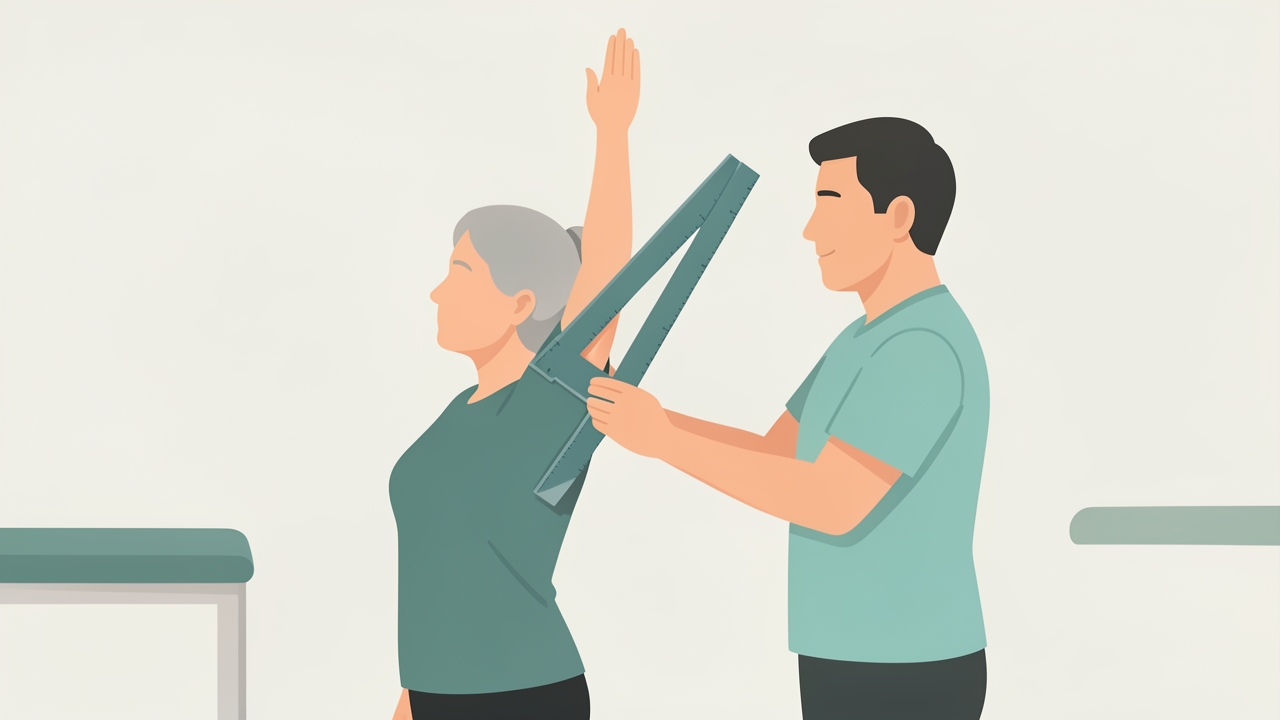
Shoulder flexion normally reaches 160–180 degrees. Conditions such as adhesive capsulitis (frozen shoulder) limit it.

Shoulder flexion normally reaches 160–180 degrees. Conditions such as adhesive capsulitis (frozen shoulder) limit it.

A real clinical example of the importance of ROM assessment is a patient who presents with a history of rotator cuff injury. The patient may exhibit limited ROM in the shoulder joint, which can be evaluated using the ASES score, with a minimum score of 30 and maximum score of 100. The ASES score is a reliable outcome measure that assesses shoulder function, pain, and ROM, with higher scores indicating better function. By assessing the patient's ROM, the physical therapist can develop a targeted treatment plan to improve shoulder function and reduce pain.

Common conditions affecting upper body and neck range of motion

There are several common conditions that can affect upper body and neck range of motion, including rotator cuff injuries, adhesive capsulitis (frozen shoulder), and cervical spine disorders. For example, a patient with cervical spine stenosis may exhibit limited ROM in the neck, which can be evaluated using the Cervical Range of Motion (CROM) device, with a sensitivity of 0.90 and specificity of 0.85. The CROM device is a reliable clinical test that assesses cervical ROM, with a normal range of 80-90 degrees.

Juvenile arthritis can limit shoulder and neck ROM. The CHAQ (0–3, higher is worse) tracks function and pain in children.

Juvenile arthritis can limit shoulder and neck ROM. The CHAQ (0–3, higher is worse) tracks function and pain in children.

A real clinical example of a common condition that affects upper body and neck ROM is a patient who presents with a history of Systemic-Onset Juvenile Rheumatoid Arthritis (SOJRA). The patient may exhibit limited ROM in the shoulders and neck, which can be evaluated using the Childhood Health Assessment Questionnaire (CHAQ), with a minimum score of 0 and maximum score of 3. The CHAQ is a reliable outcome measure that assesses functional ability and pain in children with rheumatoid arthritis, with higher scores indicating worse function. By assessing the patient's ROM, the physical therapist can develop a targeted treatment plan to improve functional ability and reduce pain.

Overview of assessment techniques

There are several assessment techniques used to evaluate upper body and neck range of motion, including the ASES score, Shoulder Flexion Test, CROM device, and CHAQ. These assessment techniques provide valuable information about the patient's functional ability and potential limitations, which can be used to develop targeted treatment plans and interventions. For example, the ASES score can be used to evaluate shoulder function and ROM, while the CROM device can be used to evaluate cervical ROM.

A real clinical example of an assessment technique is the use of the ASES score to evaluate shoulder function and ROM in a patient with a history of rotator cuff injury. The ASES score is a reliable outcome measure that assesses shoulder function, pain, and ROM, with higher scores indicating better function. By using the ASES score, the physical therapist can develop a targeted treatment plan to improve shoulder function and reduce pain.

Summary and Key Takeaways

  • Range of motion assessment is essential in healthcare, as it provides valuable information about the patient's functional ability and potential limitations.
  • Common conditions that affect upper body and neck range of motion include rotator cuff injuries, adhesive capsulitis (frozen shoulder), and cervical spine disorders.
  • Assessment techniques used to evaluate upper body and neck range of motion include the ASES score, Shoulder Flexion Test, CROM device, and CHAQ.
  • The ASES score is a reliable outcome measure that assesses shoulder function, pain, and ROM, with higher scores indicating better function.
  • The CROM device is a reliable clinical test that assesses cervical ROM, with a normal range of 80-90 degrees.

Clinical Pearl

When assessing upper body and neck range of motion, it is essential to use a combination of clinical tests and outcome measures to provide a comprehensive evaluation of the patient's functional ability and potential limitations. The ASES score and CROM device are reliable assessment tools that can be used to evaluate shoulder and cervical ROM, respectively. By using these assessment tools, physical therapists can develop targeted treatment plans to improve functional ability and reduce pain. For example, a patient with a history of rotator cuff injury may exhibit limited ROM in the shoulder joint, which can be evaluated using the ASES score, with a minimum score of 30 and maximum score of 100. The physical therapist can then develop a targeted treatment plan to improve shoulder function and reduce pain, using interventions such as shoulder flexion exercises and pain management techniques.

References

  1. Richards RR, An KN, Bigliani LU, et al. A standardized method for the assessment of shoulder function. J Shoulder Elbow Surg. 1994;3(6):347-352.

  2. Michener LA, McClure PW, Sennett BJ. American Shoulder and Elbow Surgeons Standardized Shoulder Assessment Form, patient self-report section: reliability, validity, and responsiveness. J Shoulder Elbow Surg. 2002;11(6):587-594.

  3. Audette I, Dumas JP, Côté JN, De Serres SJ. Validity and between-day reliability of the Cervical Range of Motion (CROM) device. J Orthop Sports Phys Ther. 2010;40(5):318-323.

  4. Williams MA, McCarthy CJ, Chorti A, Cooke MW, Gates S. A systematic review of reliability and validity studies of methods for measuring active and passive cervical range of motion. J Manipulative Physiol Ther. 2010;33(2):138-155.

  5. Kolber MJ, Hanney WJ. The reliability and concurrent validity of shoulder mobility measurements using a digital inclinometer and goniometer: a technical report. Int J Sports Phys Ther. 2012;7(3):306-313.

  6. Kelley MJ, Shaffer MA, Kuhn JE, et al. Shoulder pain and mobility deficits: adhesive capsulitis. Clinical practice guidelines linked to the International Classification of Functioning, Disability, and Health. J Orthop Sports Phys Ther. 2013;43(5):A1-A31.

  7. Singh G, Athreya BH, Fries JF, Goldsmith DP. Measurement of health status in children with juvenile rheumatoid arthritis (Childhood Health Assessment Questionnaire). Arthritis Rheum. 1994;37(12):1761-1769.

  8. Norkin CC, White DJ. Measurement of Joint Motion: A Guide to Goniometry. 5th ed. Philadelphia, PA: F.A. Davis; 2016.

Note: These sources support the reliability and validity of the ASES, CROM, and CHAQ tools and standard goniometric norms. They do not support several figures in the chapter, including the sensitivity/specificity values for the ASES score, the "Shoulder Flexion Test," and the CROM device, the 30-100 ASES score range, and the 80-90° cervical flexion norm. Verify or revise these figures against the primary sources before publication.

The other 11 chapters, all 144 MCQs and the flashcards are in the PhysioAI app.

Practice questions

5 sample MCQs from this course. Tap a question to see the answer.

  1. A 45-year-old male presents with a 2-month history of shoulder pain and limited range of motion after a fall onto his shoulder.

    1. What is the next step in the assessment of this patient?

    • A. Order an MRI to rule out rotator cuff tear
    • B. Perform the ASES score to evaluate shoulder function and ROM
    • C. Use the CROM device to assess cervical ROM
    • D. Administer the CHAQ to assess functional ability and pain
    Show answer

    Answer: B. The correct answer is B because the ASES score is a reliable outcome measure that assesses shoulder function, pain, and ROM, making it an appropriate next step in the assessment of this patient. Option A is a trap because while an MRI may be necessary, it is not the next step in the assessment. Option C is a trap because the CROM device is used to assess cervical ROM, which is not the primary concern in this scenario. Option D is a trap because the CHAQ is used to assess functional ability and pain in children with rheumatoid arthritis, which is not relevant to this patient.

  2. A 40-year-old male presents with a 3-month history of neck pain and limited range of motion after a motor vehicle accident.

    2. What is the most likely primary diagnosis for this patient?

    • A. Cervical spine strain
    • B. Thoracic outlet syndrome
    • C. Cervical radiculopathy
    • D. Cervical spine fracture
    Show answer

    Answer: A. The patient's history of neck pain and limited range of motion after a motor vehicle accident suggests a cervical spine strain. Option B is a trap because thoracic outlet syndrome typically presents with arm pain and paresthesia, not limited neck range of motion. Option C is incorrect because cervical radiculopathy typically presents with radiating arm pain and numbness, not just neck pain. Option D is a trap because a cervical spine fracture would likely present with more severe symptoms, such as numbness, tingling, or weakness in the arms or legs.

  3. A 30-year-old male presents with right-sided neck pain and stiffness after a minor car accident two days ago. Active cervical lateral flexion to the right is 20 degrees, but passive lateral flexion improves to 35 degrees with a soft end-feel and reproduces his pain.

    3. A 30-year-old male presents with right-sided neck pain and stiffness after a minor car accident two days ago. Active cervical lateral flexion to the right is 20 degrees, but passive lateral flexion improves to 35 degrees with a soft end-feel and reproduces his pain. What is the most likely cause of this patient's limited active cervical range of motion?

    • A. Glenohumeral joint capsular tightness
    • B. Muscle spasm secondary to soft tissue injury
    • C. Facet joint hypomobility
    • D. Nerve root irritation
    Show answer

    Answer: B. The significant improvement in range of motion with passive overpressure compared to active motion, along with a soft end-feel and reproduction of pain, is characteristic of muscle spasm or guarding. In capsular tightness, passive range would also be limited with a hard capsular end-feel. Facet joint hypomobility would typically show consistent limitation in both active and passive motion. Nerve root irritation would likely present with neurological symptoms such as radiating pain or paresthesia.

  4. A 30-year-old male presents with acute neck pain and limited range of motion after a sports-related injury.

    4. What is the most likely mechanism of injury in this patient?

    • A. Whiplash
    • B. Direct blow to the neck
    • C. Overuse injury
    • D. Muscle strain
    Show answer

    Answer: A. The correct answer is A, as whiplash is a common mechanism of injury in sports-related neck injuries. Option B is a trap, as a direct blow to the neck is possible, but it may not be the most likely mechanism of injury. Option C is a trap, as overuse injury is possible, but it may not be the most likely mechanism of injury. Option D is a trap, as muscle strain is possible, but it may not be the most likely mechanism of injury.

  5. A 50-year-old office worker presents with chronic stiffness in the neck. During cervical range of motion assessment, you note that right lateral flexion is 25 degrees with a hard end-feel, while left lateral flexion is 45 degrees with a soft end-feel.

    5. A 50-year-old office worker presents with chronic stiffness in the neck. During cervical range of motion assessment, you note that right lateral flexion is 25 degrees with a hard end-feel, while left lateral flexion is 45 degrees with a soft end-feel. What is the most likely source of the restriction on the right?

    • A. Muscle spasm
    • B. Capsular tightness
    • C. Facet joint dysfunction
    • D. Disc herniation
    Show answer

    Answer: C. A hard or bony end-feel in lateral flexion suggests restriction from the articular structures, such as the facet joints, rather than muscle spasm (which usually gives a soft or empty end-feel) or capsular tightness (often a firm end-feel but less hard). Disc herniation typically presents with radicular symptoms and myotomal weakness, not isolated lateral flexion restriction with a hard end-feel.

Flashcards

  • A patient presents with limited range of motion in the shoulder and neck. What is the first step in the assessment?

    The first step in the assessment is to perform a thorough history and physical examination, including the use of outcome measures such as the ASES score and CROM device.

  • A 50-year-old male presents with a 6-month history of shoulder pain and limited range of motion after a fall onto his outstretched arm.

    The patient's symptoms are likely due to a rotator cuff tear, and the next step in management would be to order an MRI to confirm the diagnosis and refer the patient to orthopedic surgery for further evaluation.

  • A patient presents with a 6-month history of shoulder pain and limited range of motion.

    The patient should be evaluated for potential underlying conditions, and imaging studies should be ordered to rule out underlying conditions that may be contributing to the patient's symptoms.

  • A patient presents with shoulder pain and limited range of motion after a sports injury.

    The patient may have a rotator cuff injury or scapulothoracic joint dysfunction, and physical therapy may be an appropriate management approach.

  • A 45-year-old female presents with elbow pain and limited mobility after a fall onto her outstretched arm.

    The patient's presentation suggests a possible diagnosis of olecranon bursitis, which is characterized by inflammation of the bursa that surrounds the olecranon process of the ulna.

All courses