This chapter introduces the definitions, principles, assessment frameworks, and service delivery structures that underpin safe, person-centered provision of mobility devices and transfer aids in physiotherapy practice.
Definitions and Scope of Assistive Technology
Under the US Assistive Technology (AT) Act, an assistive technology device is any item, piece of equipment, or product system, whether acquired commercially, modified, or customized, that is used to increase, maintain, or improve the functional capabilities of individuals with disabilities. An AT service is any service that directly assists a person in the selection, acquisition, or use of a device. This includes evaluation, fitting, training, and follow-up.
AT is usually described along a continuum:
- No-tech: built-up handles, positioning strategies.
- Low-tech: reachers, canes, transfer belts.
- Mid-tech: rollators, manual wheelchairs, sit-to-stand aids.
- High-tech: powered wheelchairs, ceiling hoists, computer-based controls.
Assistive technology compensates for lost function in daily living. Rehabilitation technology aims to restore or retrain function, for example treadmill systems or functional electrical stimulation. Most clinical decisions involve both.
Guiding Principles and Goals
Four principles guide every AT decision:
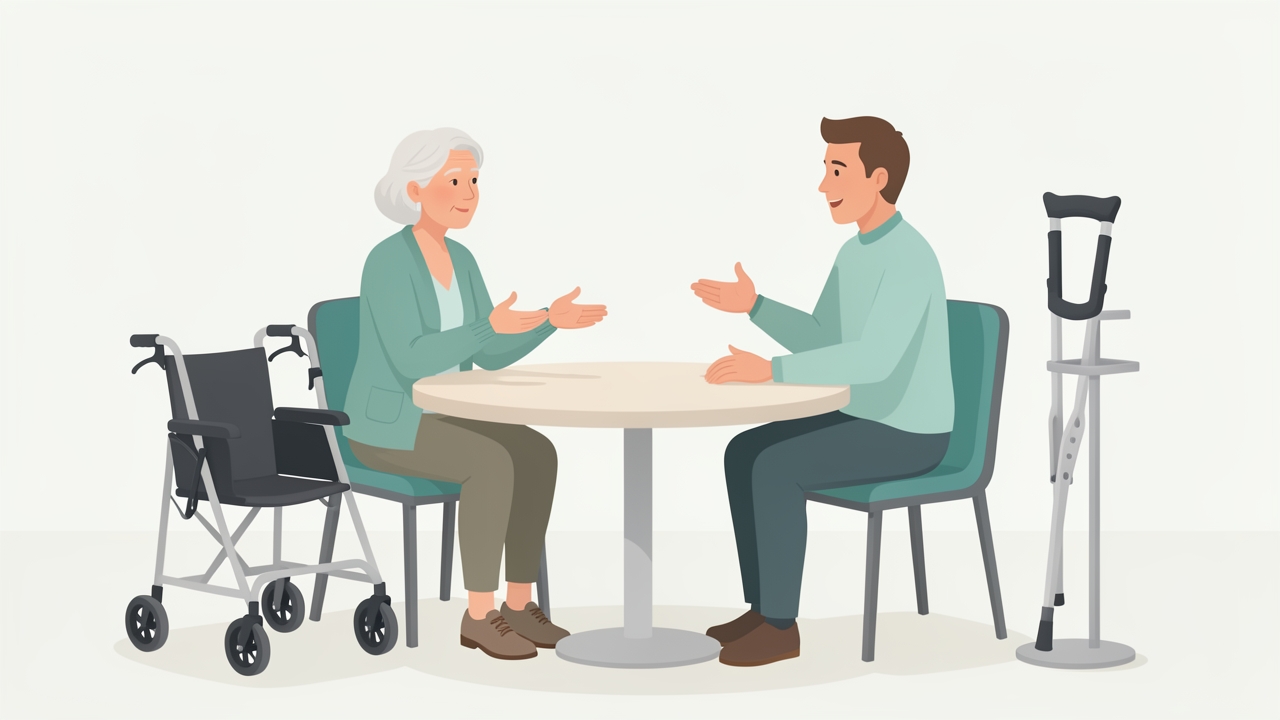
Person-centred care: the user's goals, roles, preferences and values drive device selection, not clinical convenience.
- Person-centered care. The user's goals, roles, preferences, and values drive selection. Clinical convenience does not.
- Least restrictive, most functional option. The device should support maximal safe independence without encouraging avoidable dependence or deconditioning.
- Fit across person, technology, and environment. A device that works in the clinic may fail at home or in the community.
- Provision is a process, not a product. Assessment, trial, fitting, training, and follow-up are inseparable.
Typical AT goals are safety (fall and injury reduction), independence in mobility and self-care, participation in valued activities, energy conservation, caregiver safety, and preservation of long-term health, such as upper-limb joints and skin. Goals should be written in measurable terms, for example "propel 100 m on a mixed outdoor surface independently within four weeks."
Pathophysiology and Why Device Needs Arise
Device needs follow the underlying disease trajectory.
- Multiple sclerosis (MS): Demyelination and axonal loss cause weakness, spasticity, ataxia, sensory loss, and fatigue. Fatigue and heat sensitivity (Uhthoff phenomenon) fluctuate within a day. Devices must suit variable capacity and a progressive course.
- Parkinson's disease (PD): Basal ganglia dysfunction produces bradykinesia, rigidity, postural instability, and freezing of gait. Postural reflex loss appears at Hoehn and Yahr (H&Y) stage 3.
- Stroke: Hemiparesis, hemi-inattention, and impaired motor planning affect one-sided propulsion, transfers, and device safety.
Clinical Presentation and Device Implications
| Presentation | Key considerations |
|---|---|
| MS, EDSS 6.0 (intermittent or unilateral constant assistance needed to walk about 100 m) | Cane inadequate. Consider a rollator with seat and brakes, or forearm crutches. Add a scooter or power option for community distances to conserve energy. |
| MS, EDSS 6.5 to 7.0 | Constant bilateral support needed; 7.0 means unable to walk beyond about 5 m. Wheelchair is primary mobility. |
| MS with 3/5 hip flexors, 4-/5 knee extensors, mild spasticity, moderate assistance to stand | Stand-pivot is unsafe. Use a sit-to-stand lift, slide board (if upper limbs allow), or mechanical hoist. |
| PD, H&Y stage 3, frequent falls, lives alone in a two-story home | Evaluate freezing and festination. Consider a wheeled walker with cueing strategies. Address stairs by relocating living areas to the ground floor or using a stairlift. |
| Stroke with right hemiparesis, lives alone | Consider a hemi-height manual chair for foot-assisted propulsion, a one-arm-drive system, or power mobility. Screen for neglect and cognition. |
Small apartments favor narrow-footprint, tight-turning devices. A rollator that is hard to maneuver indoors suggests reassessing the device type rather than increasing patient effort.
Person-Centered Assessment Framework
Assessment combines several models.
- ICF: a biopsychosocial framework linking body functions and structures, activities, participation, and environmental and personal factors.
- Person–Technology–Environment (HAAT/MPT): Human, Activity, Assistive Technology within a Context (Cook and Polgar). The Matching Person and Technology model (Scherer) adds the user's temperament, preferences, and psychosocial readiness.
- Team approach: physiotherapist, occupational therapist, rehabilitation engineer, supplier or technician, and, where relevant, a speech-language pathologist. The user and family are core team members.
The interview should establish the person's goals, daily routine, living arrangement, caregiver availability, transport, finances, and funding eligibility. A home or site visit, or at minimum photographs and measurements, is required for environmental fit.
Objective Measures and Reference Values
Select measures that inform device choice and later demonstrate benefit.
- Strength and range: Manual muscle testing (0–5); goniometry for hip and knee contractures. Hip flexion contracture limiting sitting needs about 90° of hip flexion for neutral seating. Modified Ashworth Scale for spasticity.
- Balance and fall risk: Berg Balance Scale (score below 45/56 suggests increased fall risk); Timed Up and Go (TUG; 13.5 s or more predicts falls in community-dwelling older adults).
- Gait speed: 10-Meter Walk Test. Normal comfortable speed is about 1.2–1.4 m/s. Below 0.8 m/s indicates limited community ambulation, and below 0.4 m/s indicates household ambulation only. In MS, the Timed 25-Foot Walk is commonly used.
- Endurance and fatigue: 6-Minute Walk Test. The Modified Fatigue Impact Scale and Fatigue Severity Scale (mean of 4 or more indicates significant fatigue).
- Disease staging: EDSS (MS), Hoehn and Yahr (PD).
- Wheelchair-specific: Wheelchair Skills Test (WST/WST-Q) and Wheelchair Outcome Measure.
- Participation and outcome: Canadian Occupational Performance Measure (COPM; a change of 2 or more points is clinically significant). QUEST 2.0 for satisfaction with the device and service. PIADS for psychosocial impact.
Also screen vision, cognition, upper-limb strength, trunk control, skin integrity, and pain, since these determine propulsion and seating requirements.
Mobility Devices: Selection and Fitting Logic
Selection is progressive: choose the simplest device that meets goals safely, and re-evaluate as the condition changes.
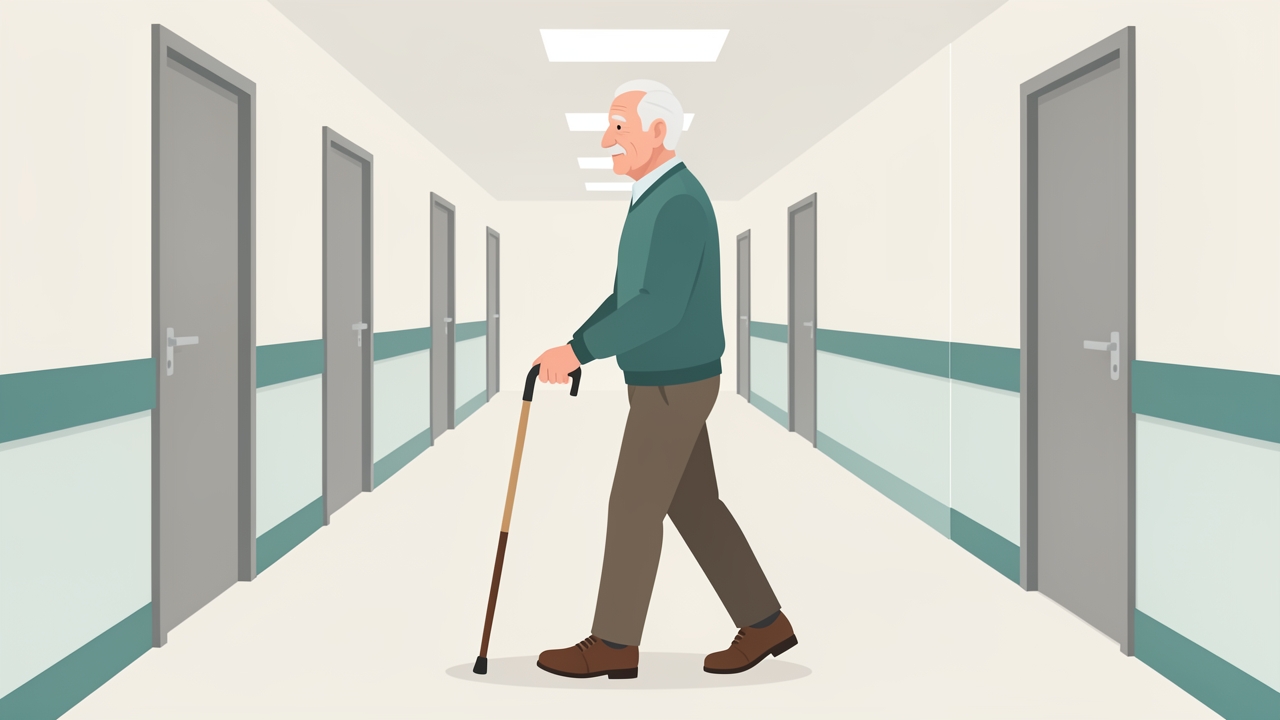
Cane handle at the greater trochanter or ulnar styloid, with 20–30° of elbow flexion. A cane offsets roughly 20–25% of body weight.
- Cane: handle at the greater trochanter or ulnar styloid, with 20–30° of elbow flexion on standing. It offsets roughly 20–25% of body weight and is inadequate for significant weakness or ataxia.
- Walkers and rollators: the same height rule applies. Rollators need functional hand braking and are unsuitable for people who cannot manage braking or who have severe freezing.
- Manual wheelchairs: ultralight models with adjustable axle position are preferred for active users. A forward axle position improves propulsion efficiency, though it reduces rear stability. Seat height should give 100–120° of elbow flexion with the hand at the top of the handrim. Seat width is about hip width plus 2.5 cm each side. Seat depth leaves about 2.5–5 cm clearance behind the knee. Footplates clear the ground by at least 5 cm.
- Outdoor and uneven terrain (such as the gardener with MS): larger or pneumatic casters, rear-wheel camber, and power-assist wheels may be appropriate. Trial the device on the actual terrain.
- Power chairs and scooters: scooters require adequate trunk control and upper-limb function. Power chairs suit people with significant fatigue, weakness, or progressive loss.
- Environment: minimum clear door width 81 cm (32 in) with 91 cm (36 in) preferred, turning space about 150 cm (60 in), and ramp slope no steeper than 1:12 (about 4.8°).
Transfer Aids
Match the aid to the person's residual ability and the caregiver's safety.
- Independent or standby assist: grab bars, raised seats, gait belts, and slide boards (usually about 60–75 cm long). Slide boards require sufficient upper-limb strength and sitting balance.
- Moderate assistance, partial weight bearing: sit-to-stand lifts, pivot discs, and stand-assist devices.
- Dependent or unsafe to stand: mechanical hoists (mobile or ceiling) with correctly sized slings.
Caregiver safety is part of the assessment. Manual lifting should be avoided, and NIOSH recommends a maximum of about 16 kg (35 lb) under ideal conditions. Train caregivers and verify competency before discharge.
Service Delivery Models and Principles
The WHO eight-step wheelchair service process is a useful template:
- Referral and appointment
- Assessment
- Prescription
- Funding and ordering
- Product preparation
- Fitting
- User training
- Follow-up, maintenance, and repairs
Delivery models include clinic-based interdisciplinary services, vendor-led supply with clinical oversight, community or outreach services, telepractice, and equipment loan or recycling schemes. Multidisciplinary teams work in parallel, interdisciplinary teams coordinate shared goals, and transdisciplinary teams blur roles. In a consumer-driven model, the user directs decisions. In a medical model, the clinician leads.
The WHO "5 Ps" (people, policy, products, provision, personnel) describe the broader system. Service principles include timeliness, equity, evidence-based prescription, user involvement, and ongoing review.
Staged Physiotherapy Management
Stage 1: Assessment and goal setting (1–2 sessions). Complete the history, measures, and environmental review. Set 2–3 COPM-based goals.
Stage 2: Trial and selection (1–3 sessions). Trial two or three options in realistic conditions. Record the effort, safety, and the user's preferences.
Stage 3: Fitting and delivery. Check pressure points, posture, and alignment. Confirm brakes, anti-tippers, and cushion function.
Stage 4: Training. Typically 2–4 sessions of 30–45 minutes, depending on the device. Training covers:
- Propulsion technique: long, smooth strokes with a low cadence. This is recommended to protect shoulders.
- Brake use and parking, and slopes, curbs, and uneven surfaces.
- Safe transfers, with progression from supervised to independent.
- Maintenance, including tire pressure and weekly checks.
- Fall recovery, skin checks, and pressure relief. For wheelchair users, relief is commonly taught as 1–2 minutes every 30 minutes.
A user given an ultralight chair without this training risks falls, shoulder pain, and device abandonment.
Stage 5: Follow-up. Review at 2–4 weeks, then 3 months, then at least annually. Re-measure the WST, COPM, and QUEST 2.0, and reassess earlier after any change in condition or relapse.
Evidence and Clinical Pearls
- Roughly one-third of devices are abandoned (about 29% in early studies). Common causes include poor user involvement, inadequate training, changing needs, and device unsuitability.
- Structured wheelchair skills training improves skill and confidence. The Wheelchair Skills Program provides graded training protocols.
- Clinical guidelines for upper-limb preservation recommend ultralight chairs, minimal push frequency, and long strokes.
- Reassess regularly in progressive conditions such as MS and PD. Plan for the next device, not only the current one.
- In MS, schedule trials and training at the person's best time of day, and avoid heat exposure. Teach energy conservation alongside the device.
- In PD, test for freezing in doorways, turns, and cluttered rooms. Combine devices with external cueing.
- Always involve the user in the final decision. A technically perfect device that the user rejects is a failure.
Red flags and contraindications: new neurological deficits or sudden functional decline (refer urgently); pressure injury or loss of sensation at the seat; uncontrolled orthostatic hypotension; cognitive or visual impairment that makes power mobility unsafe without supervision; unsafe stand-pivot transfers (use mechanical alternatives); and caregiver inability to perform handling safely.
Summary
Effective AT provision rests on person-centered goals, a structured team assessment, objective measures, and a matched device that fits the person and the environment. Mobility devices and transfer aids should be selected progressively, trialed, and fitted precisely. Delivery requires training, follow-up, and reassessment, particularly in progressive conditions like MS and PD. Following a service delivery process such as the WHO eight-step model reduces abandonment and supports safety, independence, and participation.
References
- Cook AM, Polgar JM. Assistive Technologies: Principles and Practice. 4th ed. St. Louis: Elsevier Mosby; 2015.
- World Health Organization. Wheelchair Service Training Package – Basic Level. Geneva: WHO; 2012.
- World Health Organization; UNICEF. Global Report on Assistive Technology. Geneva: WHO; 2022.
- World Health Organization. International Classification of Functioning, Disability and Health (ICF). Geneva: WHO; 2001.
- Scherer MJ, Craddock G. Matching Person & Technology (MPT) model and accompanying assessment process. Technology and Disability. 2002;14(3):125-131.
- Phillips B, Zhao H. Predictors of assistive technology abandonment. Assistive Technology. 1993;5(1):36-45.
- Consortium for Spinal Cord Medicine. Preservation of Upper Limb Function Following Spinal Cord Injury: A Clinical Practice Guideline for Health-Care Professionals. Washington, DC: Paralyzed Veterans of America; 2005.
- Kirby RL, et al. Wheelchair Skills Program (WSP) Manual. Halifax: Dalhousie University; 2016.