Anatomy and Physiology of Balance
Balance, or postural control, is the ability to keep the centre of mass within the base of support during static and dynamic tasks. It depends on continuous integration of three sensory systems: vision, the vestibular apparatus, and somatosensation (mainly proprioception from muscle spindles, Golgi tendon organs, and joint receptors, plus cutaneous input from the feet). The central nervous system combines these inputs in the cerebellum, brainstem, basal ganglia, and motor cortex, then produces postural responses through the musculoskeletal system.
Three functional strategies work together:
- Ankle strategy: small, slow perturbations are corrected by tibialis anterior, gastrocnemius-soleus, and intrinsic foot muscles acting around the ankle.
- Hip strategy: larger or faster perturbations recruit hip abductors, extensors, and trunk musculature.
- Stepping (protective) strategy: when the centre of mass exits the base of support, a compensatory step restores stability. Stepping reaction time and step length are sensitive markers of reserve capacity.
Anticipatory postural adjustments, which precede voluntary movement, also depend on cortical and cerebellar timing. Balance is therefore a neuromuscular skill with sensory, motor, and cognitive components, not simply a measure of leg strength.
Age-Related Changes in the Neuromuscular System
Ageing affects every component of the balance system, usually in a combined and progressive way:
- Sarcopenia: muscle mass declines roughly 3–8% per decade after age 30, accelerating after 60. Type II (fast-twitch) fibres atrophy preferentially, reducing power output and rate of force development (RFD).
- Motor unit loss: denervation and reinnervation cycles reduce motor unit number, impairing fine force control.
- Power decline: muscle power falls faster than strength, and power is the best predictor of the ability to recover from a perturbation.
- Proprioceptive decline: joint position sense and vibration sense degrade, especially in the ankles and toes.
- Vestibular loss: hair cell and vestibular ganglion cell loss increases dependence on vision and somatosensation.
- Visual change: reduced contrast sensitivity, presbyopia, and cataract increase depth-perception errors.
- Central changes: slower processing speed, longer reaction times, and reduced attentional capacity make dual-tasking more error-prone.
- Musculoskeletal change: reduced ankle dorsiflexion range, stiffer tendons, and reduced foot sensation alter the mechanics of gait and standing.
Many older adults also have polypharmacy (sedatives, antihypertensives, antidepressants, and antipsychotics), which adds dizziness, orthostatic hypotension, and sedation to these age-related changes.
Pathophysiology of Falls
Falls rarely have a single cause. The most useful conceptual model is the physiological profile approach (Lord, Menz & Tiedemann, 2003), which identifies deficits across domains: visual function, sensation, muscle strength and power, reaction time, and balance. Falls usually occur when a perturbation (a trip, a slip, or a sudden change in task demand) exceeds the person's reserve capacity. Frailty and cumulative deficits lower that reserve, so the same perturbation becomes a fall for one person and a recovered stumble for another.
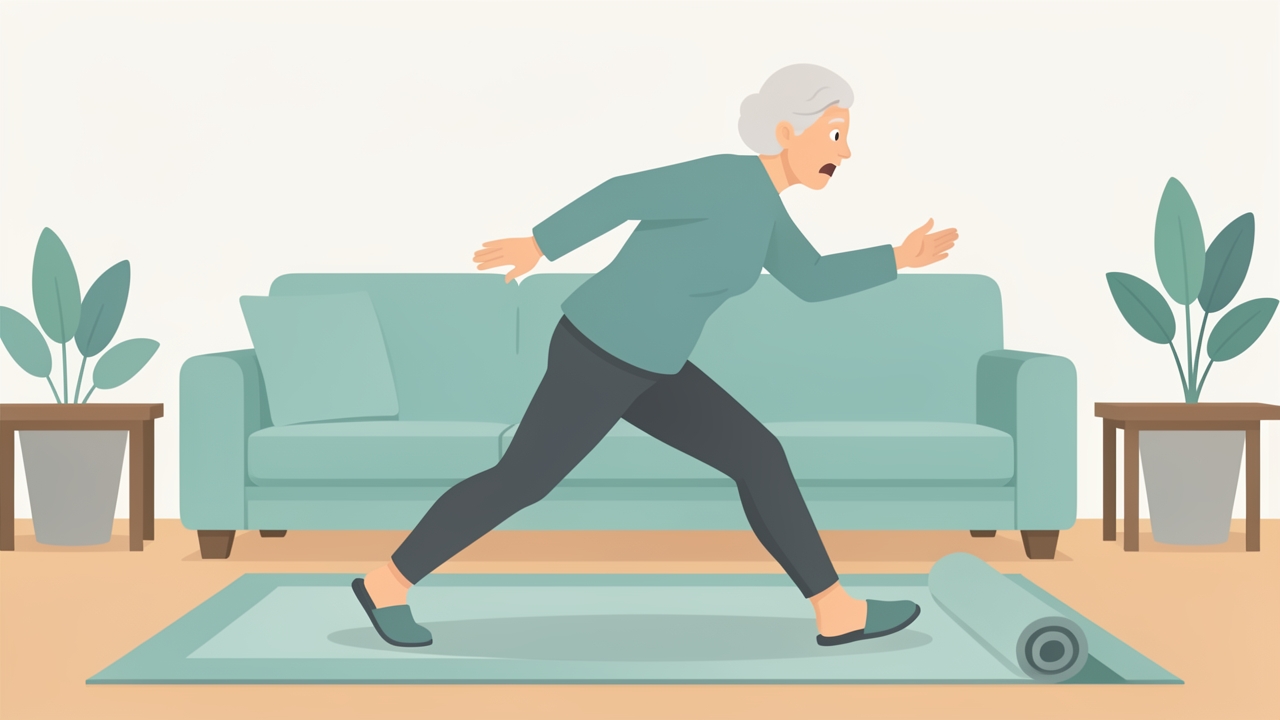
A trip becomes a fall only when the perturbation exceeds reserve capacity. A fast protective step is what recovers it.
Falls in older adults are also commonly associated with postural hypotension, medication effects, cognitive impairment, and environmental hazards. Fear of falling can cause a self-restricting cycle of reduced activity, further deconditioning, and increased fall risk.
Clinical Presentation
Clinical presentations commonly include:
- A history of one or more falls in the past 12 months, or a near-fall (stumble or recovery).
- Reported unsteadiness on turning, standing from a chair, or walking on uneven surfaces.
- Reduced walking speed, shorter step length, and wider base of support.
- Need for a hand-hold or furniture when rising or stepping.
- Fear of falling, often reported as curtailed community participation.
- Dizziness on standing or with head movements, sometimes reported as light-headedness rather than vertigo.
- Foot complaints, reduced sensation, or footwear that compromises stability.
Clinicians should ask directly about the circumstances of each fall: time of day, activity, footwear, lighting, whether the person lost consciousness, and whether they could get up unaided. A person who cannot get up after a fall ("long lie") warrants urgent review.
Screening and Initial Assessment
A structured falls assessment should include:
- Falls history: number, circumstances, injuries, and time since last fall.
- Medication review: especially sedatives, antihypertensives, diuretics, and psychoactive drugs.
- Orthostatic vital signs: measure supine for 5 minutes, then standing at 1 and 3 minutes. Orthostatic hypotension is a fall of ≥20 mmHg systolic or ≥10 mmHg diastolic.
- Vision and footwear: check acuity and screen for cataract or glaucoma.
- Sensation: monofilament (10 g) at the first metatarsal and great toe, and vibration sense using a 128 Hz tuning fork at the great toe.
- Cognitive screen: for example, the Mini-Cog or MoCA, because executive function affects dual-task performance.
- Home and environmental review: lighting, rugs, grab rails, and bathroom setup.
Standardised Outcome Measures and Normative Values
Use a battery of tests, not a single score. Core measures include:
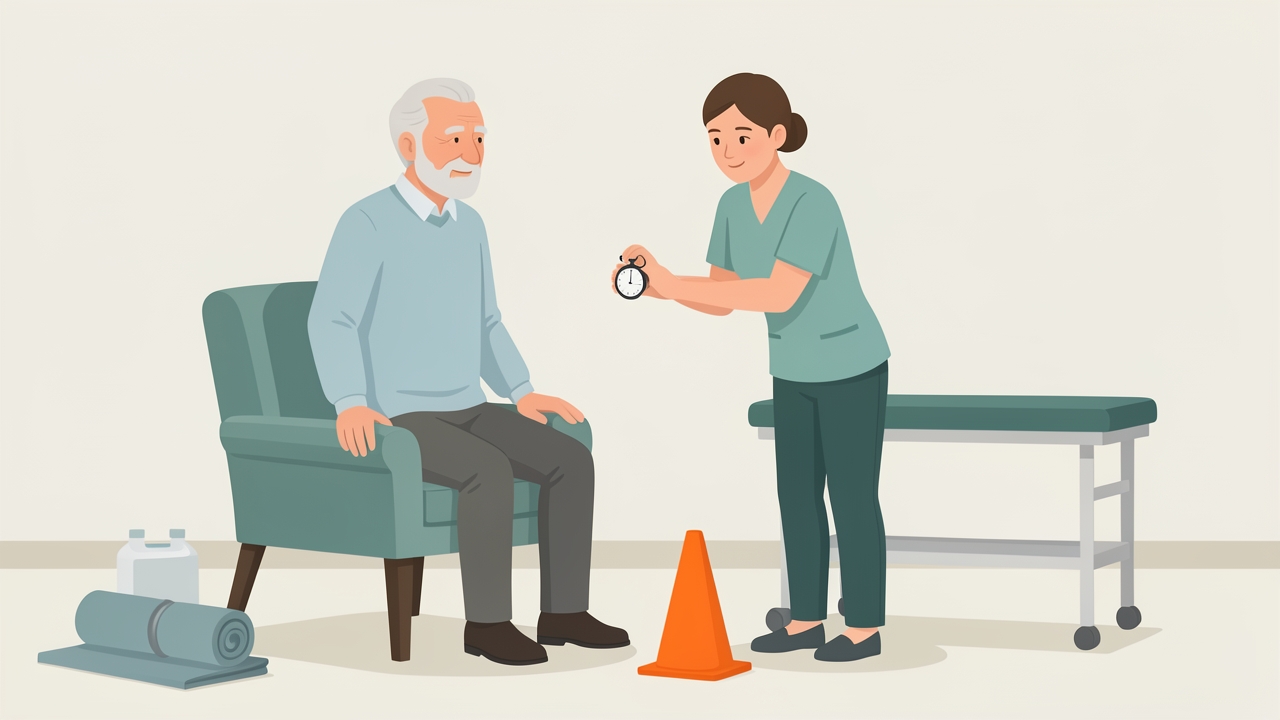
Timed Up and Go: rise, walk 3 m, turn at the marker, walk back and sit. 12 s or more flags increased fall risk.
- Timed Up and Go (TUG): time to rise from a chair, walk 3 m, turn, return, and sit. Under 10 s is typical for community-dwelling adults; ≥12 s indicates increased fall risk, and >13.5 s is commonly used as a predictive cut-off (Shumway-Cook et al., 2000).
- Berg Balance Scale (BBS): 14 items scored 0–4 (maximum 56). Scores of ≤45 indicate increased fall risk in community-dwelling older adults.
- 30-Second Chair Stand (30CST): number of full stands in 30 s with arms crossed. Normative lower bounds (Rikli & Jones) for women and men aged 60–64 are about 12 and 14, falling to about 9 and 10 at ages 80–84. Scores below the lower bound of the age norm indicate weakness and elevated risk.
- Five Times Sit-to-Stand (5STS): times to complete five stands. Times >15 s are associated with increased fall risk.
- Short Physical Performance Battery (SPPB): balance (side-by-side, semi-tandem, tandem stands held for 10 s), 4 m gait speed, and chair stands. Total scores <10 are associated with increased risk of disability and falls (Guralnik et al., 1994).
- Gait speed (4 m): normal is roughly 1.0–1.2 m/s. Speeds <0.8 m/s are associated with increased risk, and <1.0 m/s warrants further assessment.
- Functional Reach Test: normal reach is typically >25 cm; reaches under about 15 cm indicate high risk.
- Falls Efficacy Scale-International (FES-I): 16–64 points; scores ≥23 indicate high concern about falling.
Where available, instrumented measures such as force plate sway (centre-of-pressure velocity), or rapid force testing with a dynamometer, provide more sensitive baseline and progress data.
Physiotherapy Management: Staged Progression
Management should be staged according to the person's capacity, and progressed when criteria are met. Each stage should include strength, balance, and functional tasks.
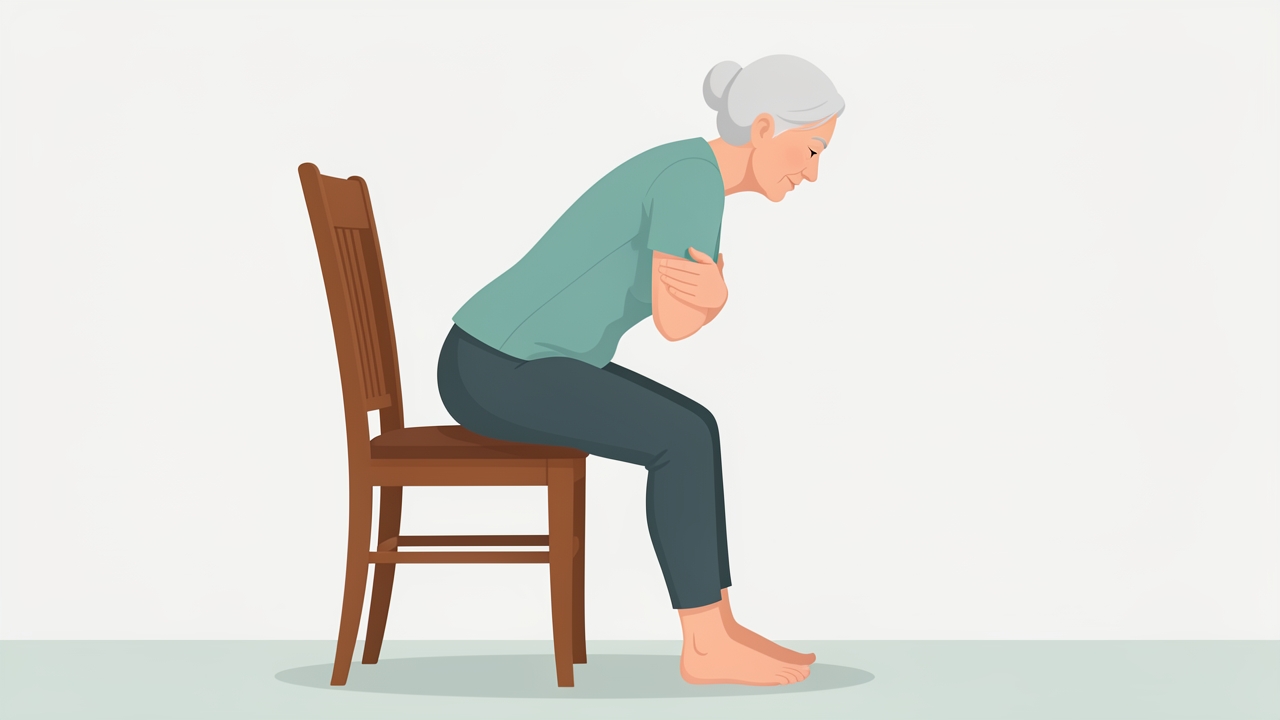
Stage 1: sit-to-stand from a firm chair with arms crossed, 2–3 sets of 8–10.
Stage 1: Foundation (weeks 0–4)
- Goal: safe independent standing and stepping with supervision where needed.
- Strength: sit-to-stand from a firm chair (2–3 sets of 8–10), heel raises (2–3 sets of 10–12), hip abduction and knee extension in standing or sidelying, with progression to resistance bands.
- Balance: static standing with feet in a split or semi-tandem stance, weight shifts, and reaching tasks within the base of support.
- Criteria to progress: stands from chair without upper-limb assistance; holds semi-tandem stance for 10 s.
Stage 2: Challenge (weeks 4–12)
- Goal: dynamic balance and multi-directional control.
- Strength: step-ups, sit-to-stand from lower surfaces, loaded heel raises, and single-leg stance progressions.
- Balance: tandem walking, narrow base of support, eyes-closed standing on firm surfaces, head turns, and reaching with weight transfer.
- Criteria to progress: tandem stance for 30 s; TUG <12 s; 5STS <15 s.
Stage 3: Reactive and dual-task training (weeks 12–24)
- Goal: reactive stepping, perturbation recovery, and task-specific performance.
- Balance: external perturbations (manual nudges at the pelvis or shoulders), stepping reaction drills, obstacle negotiation, and dual-task walking with cognitive load.
- Power: loaded sit-to-stand emphasising speed; step-up with rapid lift; medicine ball or light resistance throws in standing.
- Criteria for discharge to self-management or a community programme: safe performance of community tasks, BBS >50, and reduced fear of falling (FES-I falls).
Throughout all stages, include walking or aerobic activity (initially 10–20 minutes, progressing to 30 minutes) and education on footwear, home hazards, and safe floor recovery (transferring to a sturdy chair or kneeling-then-stand).
Dosage and Programme Design
The most robust evidence supports exercise programmes with a balance and strength component delivered at a dose of at least 3 hours per week, sustained for six months or longer (Sherrington et al., 2019). Practical parameters:
- Frequency: at least 3 sessions per week; daily home practice of balance tasks is advisable.
- Intensity: challenging but safe. Progress when the current task is performed with good control, and reduce if pain, dizziness, or prolonged fatigue occurs.
- Volume: 2–3 sets of 8–12 repetitions for strength; 3–5 minutes of balance practice per block, with rest.
- Individualisation: the Otago Exercise Programme (Campbell & Robertson) is a well-evidenced, home-based structure of this type, with progression tailored to ability.
- Adherence: group or community-based delivery, with home programmes, improves retention. Sustained supervision and feedback increase adherence.
Red Flags and Contraindications
Refer or pause training if the following are present:
- Syncope or near-syncope, including with exertion, or a symptomatic orthostatic drop as above. Screen for cardiac causes (aortic stenosis, arrhythmia) before progressing.
- Chest pain, palpitations, or unexplained dyspnoea on exertion.
- New neurological signs: focal weakness, speech change, facial droop, or sudden imbalance with headache (possible stroke).
- Unexplained weight loss, night pain, or fever, which may indicate malignancy or infection.
- Recent fracture or suspected osteoporotic fracture that has not been investigated.
- Long lie after a fall, with possible rhabdomyolysis or injury.
- Uncontrolled hypertension (resting systolic >180 or diastolic >110 mmHg) before exercise.
- Acute illness or infection, or significant medication changes, until stabilised.
- Severe cognitive impairment that prevents safe participation without close supervision.
Evidence Base
Systematic reviews consistently show that exercise reduces the rate of falls in community-dwelling older adults. Sherrington et al. (2019) found that exercise programmes reduced the rate of falls by about 23% overall (rate ratio approximately 0.77), with the greatest benefit from programmes emphasising balance and progressive strength and of a dose of at least 3 hours per week. The World Guidelines for Falls Prevention and Management (Montero-Odasso et al., 2022) recommend multifactorial assessment, with exercise as the central intervention for people at risk.
Clinical Pearls
- Measure reserve, not just performance. A person who passes the BBS but takes 12 s on the TUG may still be at high risk under real-world perturbations.
- Test under dual-task conditions. Walking while counting backwards often reveals deficits that single-task tests miss.
- Address fear of falling. High FES-I scores predict activity restriction, which accelerates deconditioning.
- Check orthostatic blood pressure every time a person has had a medication change or reports dizziness.
- Train the stepping response. Stepping practice reduces falls more effectively than static balance alone in many trials.
- Teach safe floor recovery to people who have fallen and cannot get up, because a long lie is a major predictor of morbidity.
- Discuss the trade-off. Some older adults restrict activity to avoid falls. Explain that controlled exposure to challenge is the goal.
Summary
Balance is a sensorimotor skill that depends on vision, vestibular function, proprioception, muscle power, and central processing. Ageing erodes each of these systems, and falls usually reflect a loss of reserve capacity rather than a single deficit. A thorough assessment combines falls history, orthostatic testing, sensory and cognitive screening, and validated measures such as the TUG, BBS, 30CST, 5STS, and SPPB against age-referenced norms. Management is staged, progressing from foundation strength and static balance through dynamic and reactive training to task-specific and dual-task practice. Evidence supports at least 3 hours per week of challenging balance and strength exercise sustained over months. Clinicians must screen for red flags, including syncope, neurological change, and long lie, before progressing training.
References
- Sherrington C, Fairhall NJ, Wallbank GK, et al. Exercise for preventing falls in older people living in the community. Cochrane Database of Systematic Reviews. 2019;(1):CD012424.
- Sherrington C, Michaleff ZA, Fairhall N, et al. Exercise to reduce falls in older adults: an updated meta-analysis. British Journal of Sports Medicine. 2017;51(24):1750–1758.
- Montero-Odasso M, van der Velde N, Martin FC, et al. World guidelines for falls prevention and management for older adults: a global initiative. Age and Ageing. 2022;51(9):afac205.
- Lord SR, Menz HB, Tiedemann A. A physiological profile approach to falls risk assessment and prevention. Physical Therapy. 2003;83(3):237–252.
- Podsiadlo D, Richardson S. The timed "Up & Go": a test of basic functional mobility for frail elderly persons. Journal of the American Geriatrics Society. 1991;39(2):142–148.
- Berg KO, Wood-Dauphinee SL, Williams JI, Maki B. Measuring balance in the elderly: validation of an instrument. Canadian Journal of Public Health. 1992;83(Suppl 2):S7–S11.
- Guralnik JM, Simonsick EM, Ferrucci L, et al. A short physical performance battery assessing lower extremity function: association with self-reported disability and prediction of mortality and nursing home admission. Journal of Gerontology. 1994;49(2):M85–M94.