Clinical learning ·
How We Think About Clinical Reasoning
Clinical reasoning is not knowing more. It is thinking clearer under pressure. The principles behind PhysioAI and a simple loop for every physio case.

physioai
Instagram post
1/10






Knowing every answer will not make you a good physiotherapist. This article explains the three principles PhysioAI is built on, and a simple reasoning loop you can run on any case, from a viva to your first real patient.
Key takeaways
- Clinical reasoning is not knowing more. It is thinking clearer under pressure.
- Every answer should follow the chain: anatomy, pathology, test, treatment.
- In healthcare, a confident wrong answer is worse than no answer at all, so answers should be grounded in real material and show their source.
- Rule out harm first. Screen for red flags before you settle on a plan.
- Confidence comes from repetition, and the safest place to make mistakes is in practice, not on a patient.
The gap between passing and practising
You can pass every exam and still freeze in front of your first real patient. Textbooks teach conditions. Exams test recall. The clinic asks a different question: what do you do next, for this person, right now?
Most students recognise the symptoms of this gap. You know the textbook but freeze when asked for differentials. You miss the one must-not-miss condition. You explain the diagnosis correctly, and the patient still does not understand it. None of these are knowledge problems. They are thinking problems. That gap between passing and practising is where PhysioAI works.
Three principles behind PhysioAI
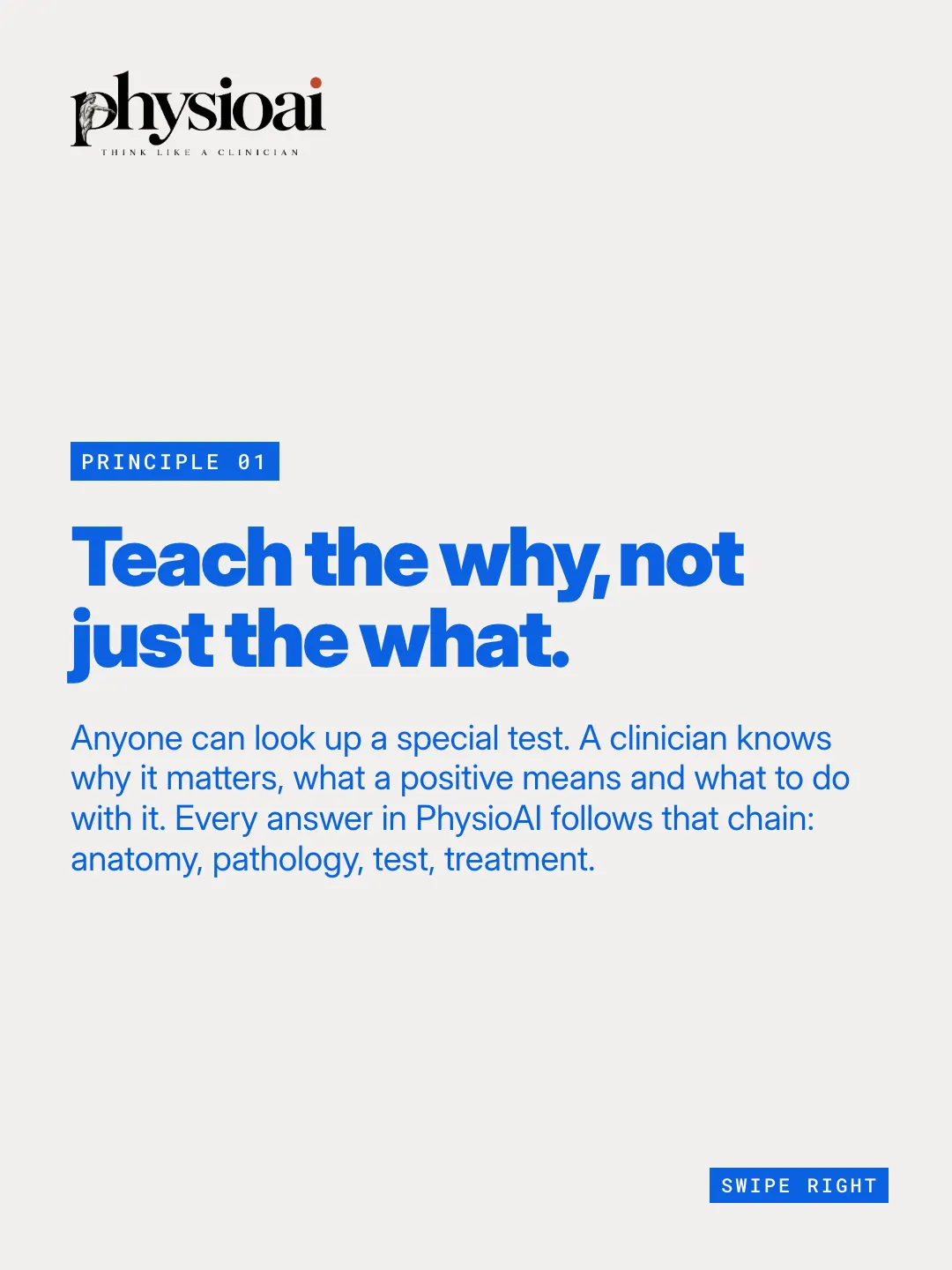
1. Teach the why, not just the what
Anyone can look up a special test. A clinician knows why it matters, what a positive result means and what to do with it. Every answer in PhysioAI is meant to follow that chain: anatomy, pathology, test, treatment. If you can walk a condition through all four links, you can usually handle the follow-up question an examiner or a patient throws at you.
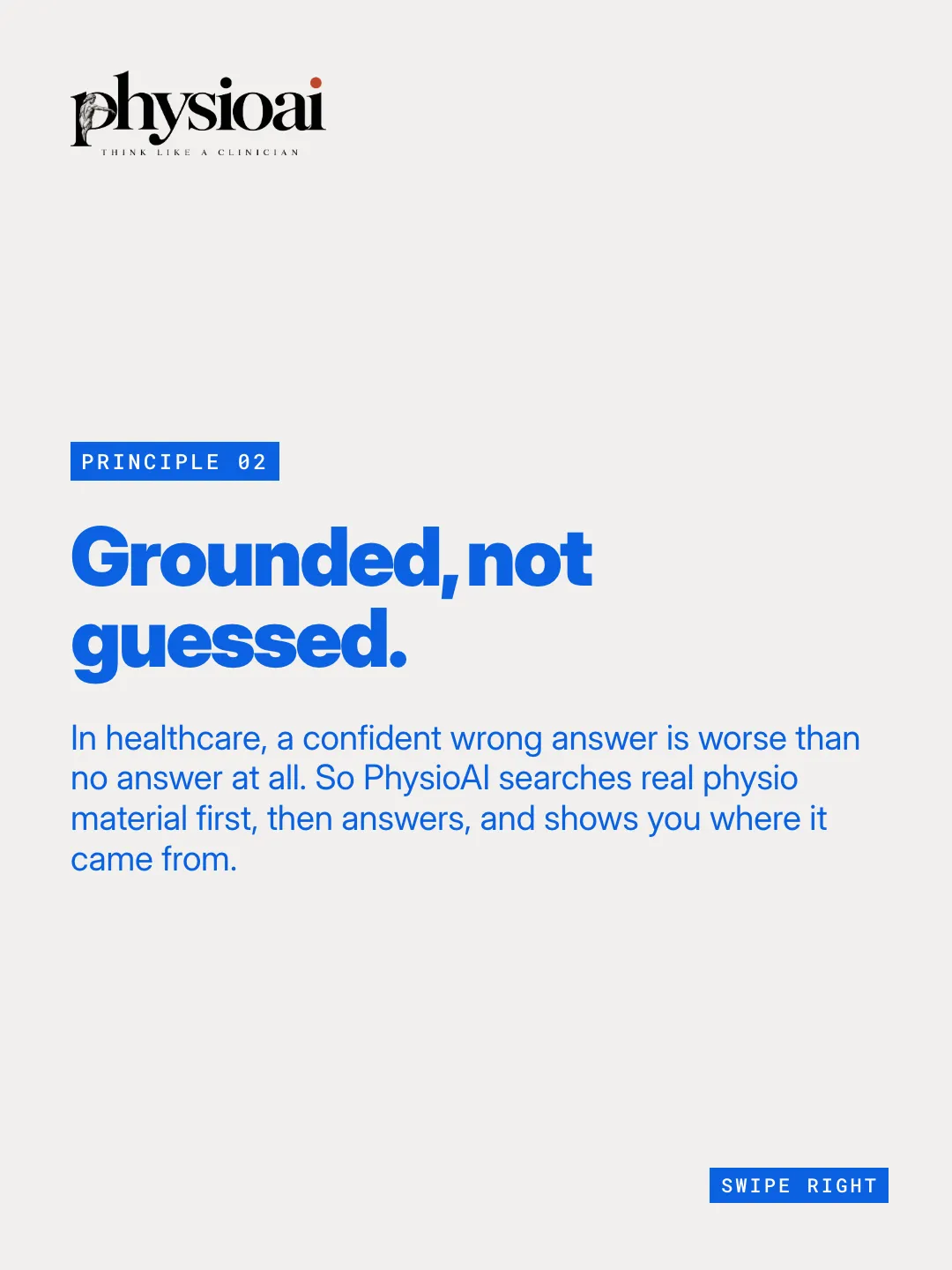
2. Grounded, not guessed
In healthcare, a confident wrong answer is worse than no answer at all. So PhysioAI searches real physiotherapy material first, then answers, and shows you where the answer came from. Synergist, the PhysioAI tutor, returns answers with numbered citations so you can check them.
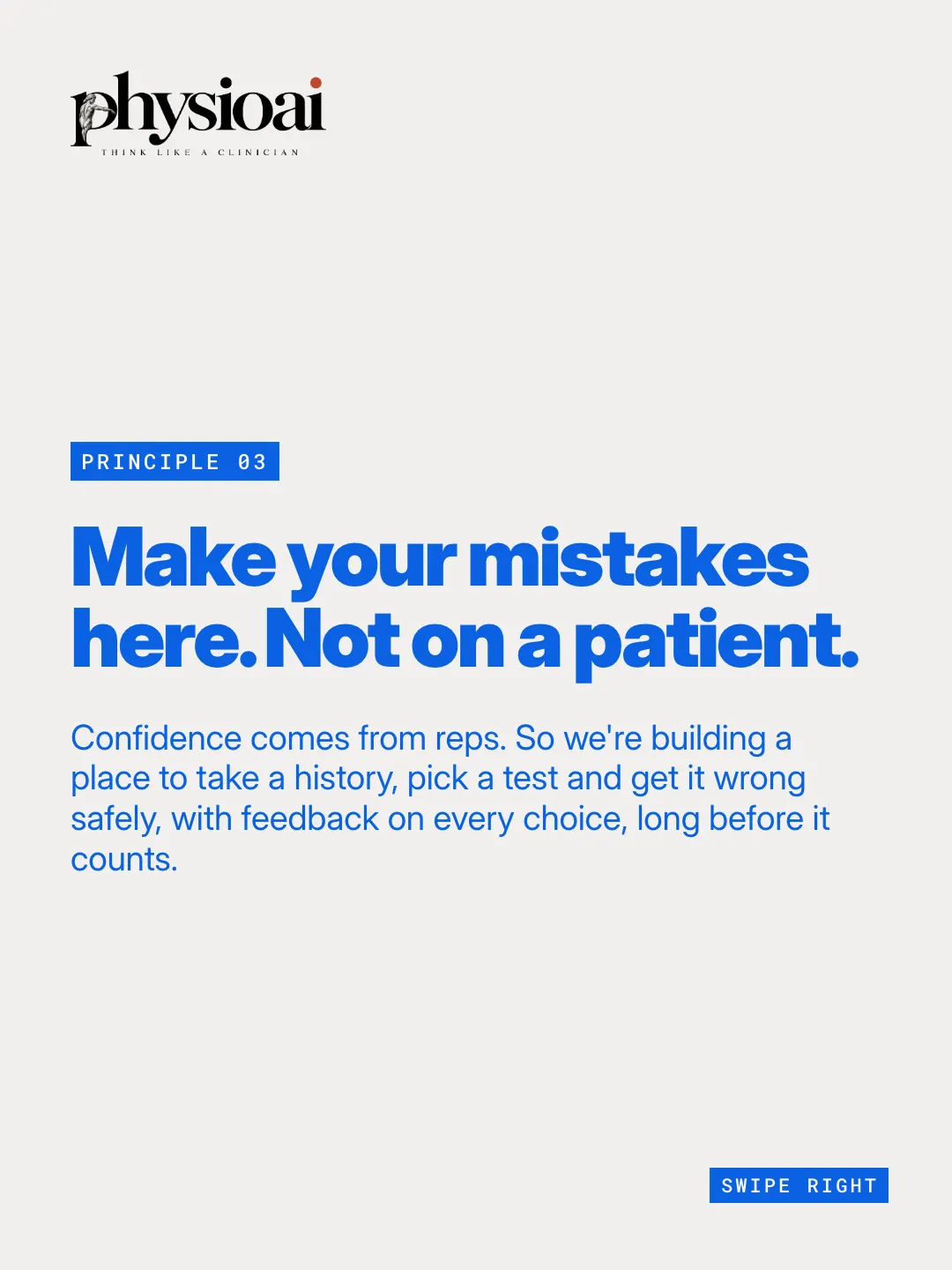
3. Make your mistakes here, not on a patient
Confidence comes from repetitions. That is why PhysioAI is building a place to take a history, pick a test and get it wrong safely, with feedback on every choice, long before it counts.
One loop for every case
A useful way to structure reasoning is a single loop you run on every case:
Cue → Differential → Safety → Plan → Explain → Reflect
Take an anchor case: a 35-year-old desk worker with dull low back pain.
Cue and hypothesis
Start with what the patient gives you and ask why. Age, occupation, the quality of the pain and what makes it better or worse all generate hypotheses. Write down why each hypothesis fits before you move on.
Rank your differentials, and do not anchor
The most common error in reasoning is locking onto the first idea. Build a ranked list of differentials instead, and keep a separate must-not-miss list. Read the must-not-miss list first.
Rule out harm first
For low back pain, the serious conditions to screen for include cauda equina syndrome, fracture, infection and malignancy. The decision here is simple to state and hard to practise: refer urgently, or treat conservatively. Examiners reward the habit of screening for red flags every time, not only when the case looks worrying.
See systematically
When imaging is part of the case, look in a fixed order: alignment, bone, soft tissue. Describe what you see before you read the report, then link each finding to its clinical implication.
Think function, not just tissue
The ICF framework moves you from body function to activity to participation. For the desk worker, that means linking the impairment to sitting tolerance and work, not only to a sore segment. Goals written in functional terms are the goals examiners and patients both want.
Justify your plan
Choose progressions and dosage you can defend. A one-paragraph explanation of why you chose an intervention, and what evidence supports it, is what makes you sound like a clinician in a viva.
Be understood
A correct explanation that the patient does not follow is not a finished job. Use plain language and an analogy where it helps, then check understanding. Adherence drives outcomes, and adherence starts with being understood.
Perform, then remember deliberately
Reasoning only becomes performance under time pressure, which is what OSCEs test. Afterwards, review where you went wrong and spend most of your practice time on your weakest areas, not your favourite topics.
Not one tool, one loop
The whole loop compresses into a chain of questions: why, what else, what must not be missed, what do I see, what does it mean for function, how do I justify the plan, was I understood, can I do it under pressure, and will I remember it. Try it on one case today, and ask one "why" you have been stuck on.
We are not building an app physios use. We are building physios who think better.
Where PhysioAI fits
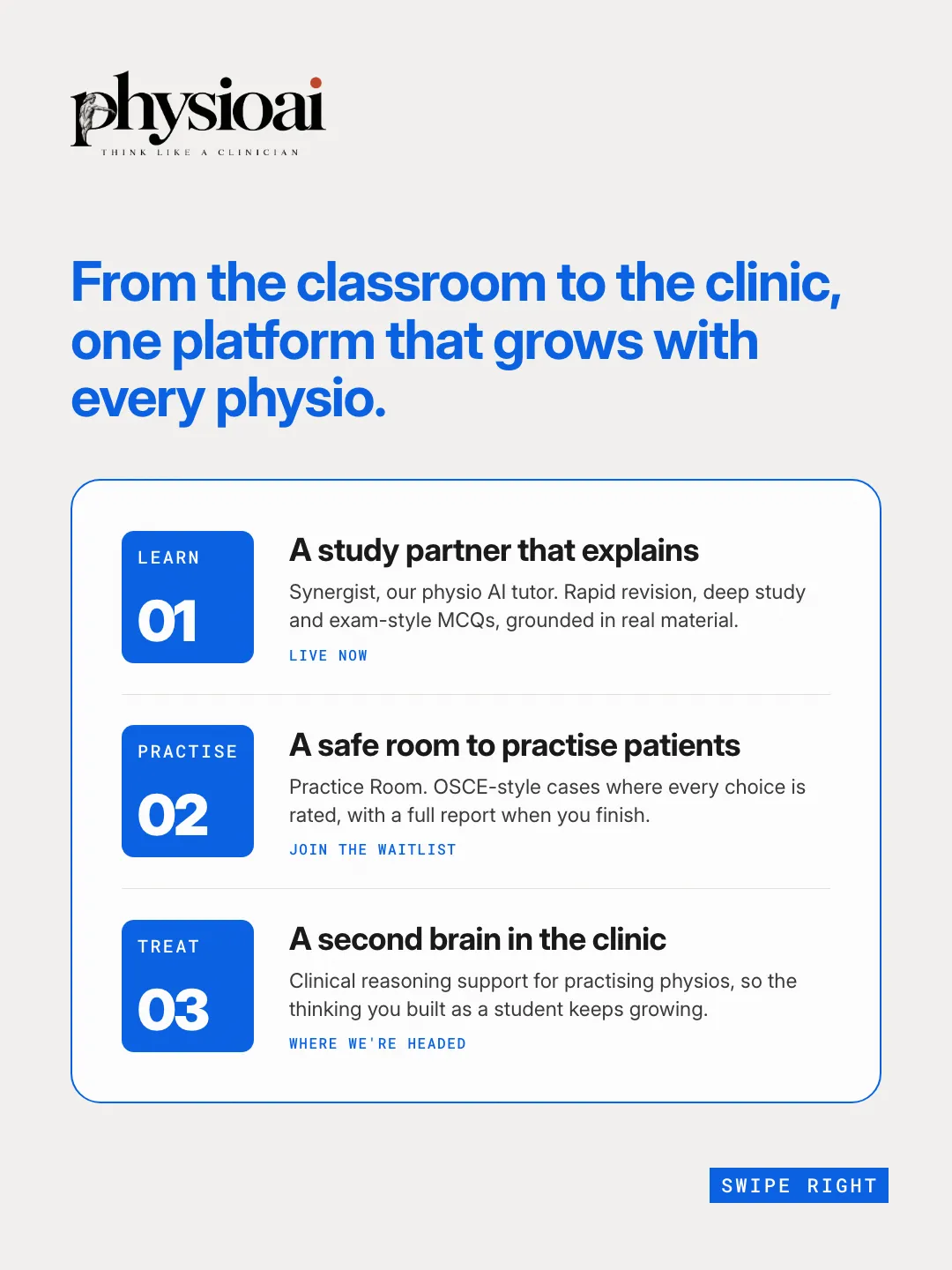
PhysioAI is designed to grow with a physiotherapist from the classroom to the clinic:
- Learn. Synergist, the AI tutor, offers Rapid revision and Deep Study answers with citations, ending with an exam-style practice MCQ.
- Practise. Patient Simulator (called Practice Room in the app) is an OSCE-style simulator with fictional patients. Each turn you choose what to ask, examine, screen or plan, every decision is rated from Best to Unsafe, and you get a full report at the end. Access is through a waitlist in the app.
- Treat. Case Workup supports practising physiotherapists with a red-flag check, an evidence-backed differential and patient documents, while the clinician keeps the final call.
If you want to rehearse the reasoning loop on realistic cases, join the Patient Simulator waitlist.