Founder notes ·
Who Actually Pays for Free AI?
Every AI answer has two prices: what the user pays and what the business pays. Notes from building PhysioAI on the cost you never see and how to manage it.

physioai
Instagram post
1/12

Every AI answer has two prices: the one the user sees, which is usually zero, and the one the business behind it pays, which never is. These are notes from building PhysioAI on the price you never see, and the six habits that keep an AI product affordable to run.
Key takeaways
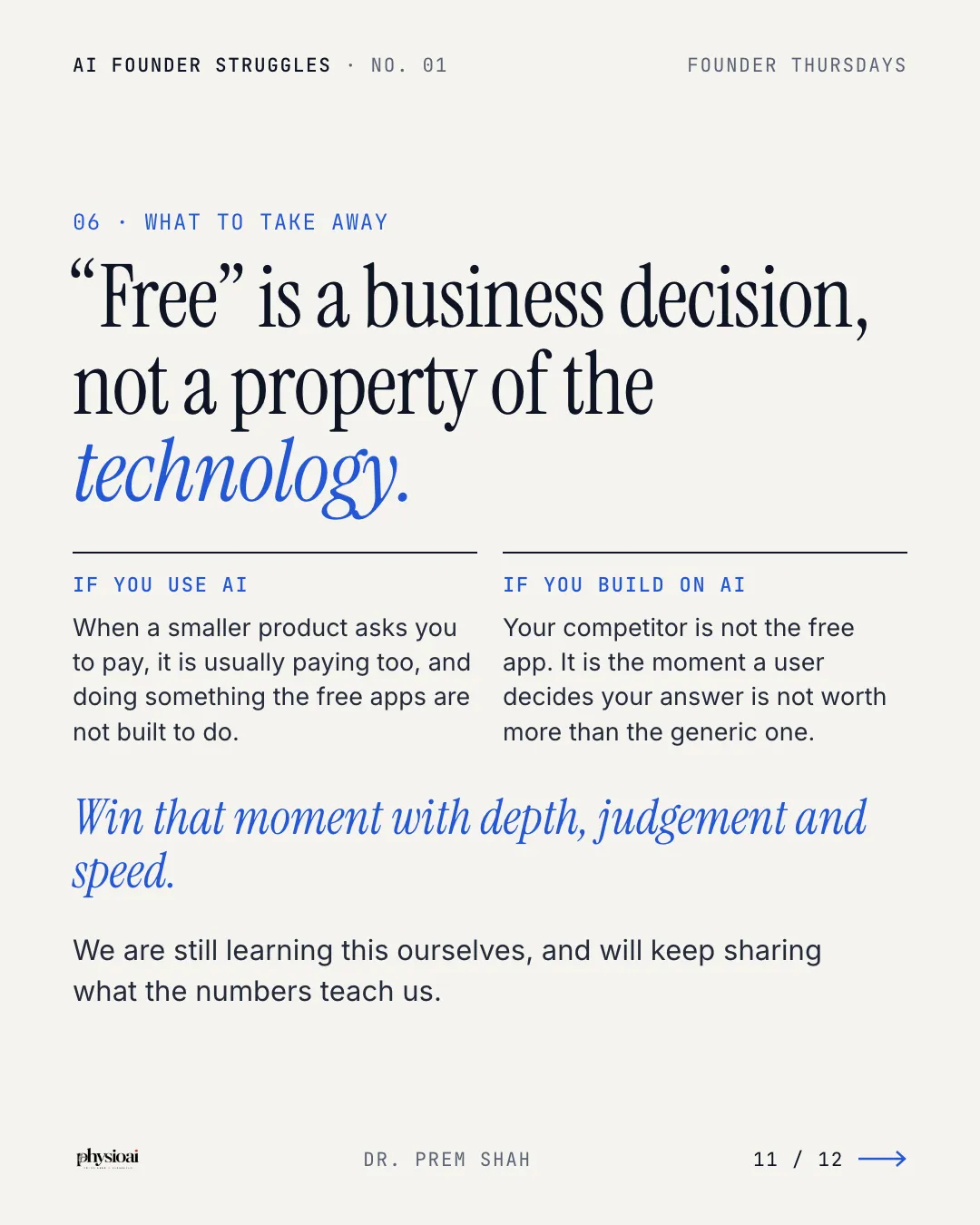
- "Free" is a business decision, not a property of the technology.
- Businesses building on AI do not get a free app. They get a meter that runs on every request.
- Ten times the users means roughly ten times the bill, and the most loyal users are the most expensive to serve.
- Three trade-offs keep returning: price vs wallet, generosity vs survival, and cheaper models vs trust.
- Know your cost per answer, route by difficulty, cache repeated answers, send less to the model, cap questions rather than days, and re-run the maths often.
Every AI answer has two prices
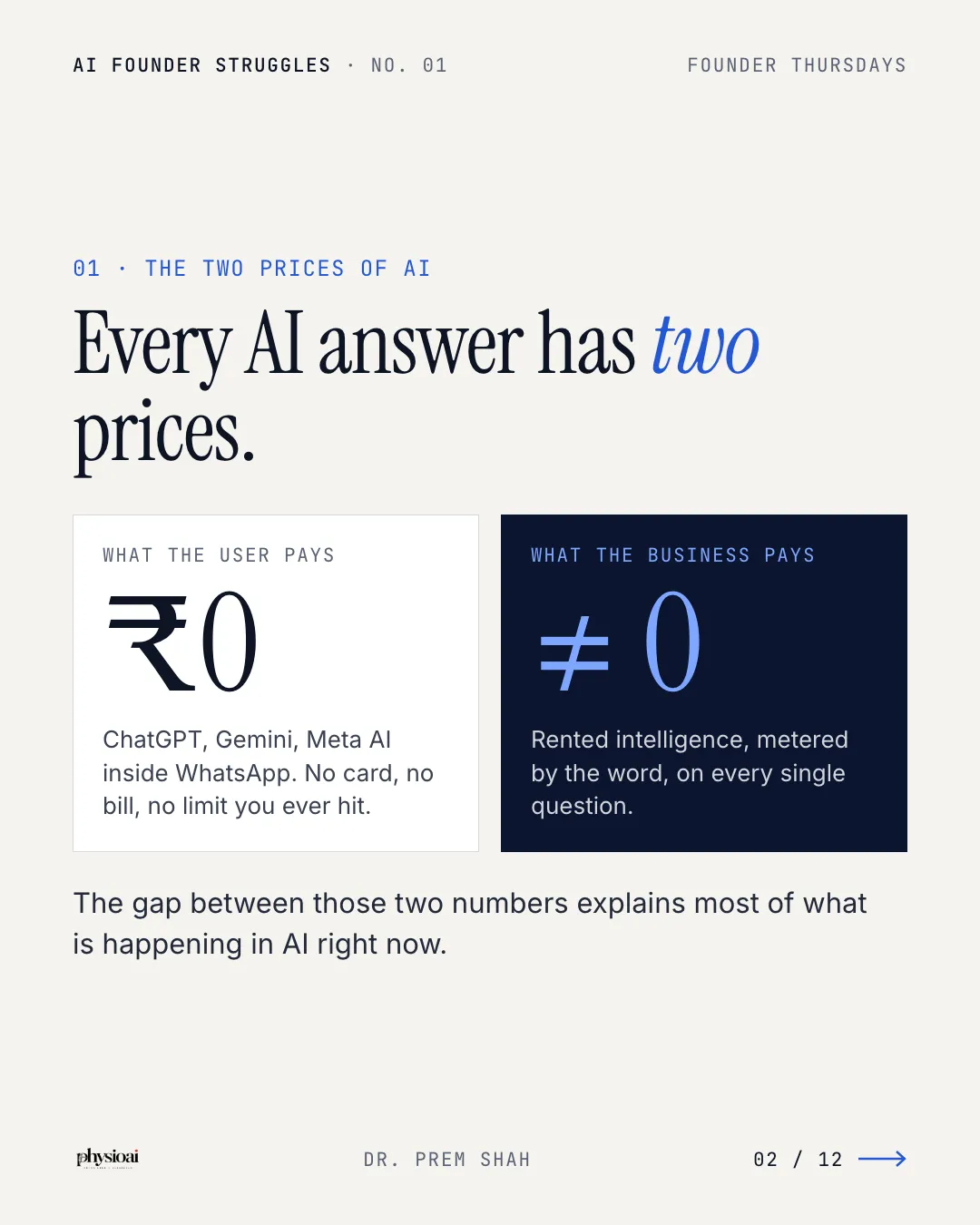
For the user, the price is zero. ChatGPT, Gemini and Meta AI inside WhatsApp ask for no card, send no bill and set no limit most people ever hit.
For the business, the price is never zero. It is rented intelligence, metered by the word, on every single question. The gap between those two numbers explains most of what is happening in AI right now.
Free AI is a strategy, not generosity
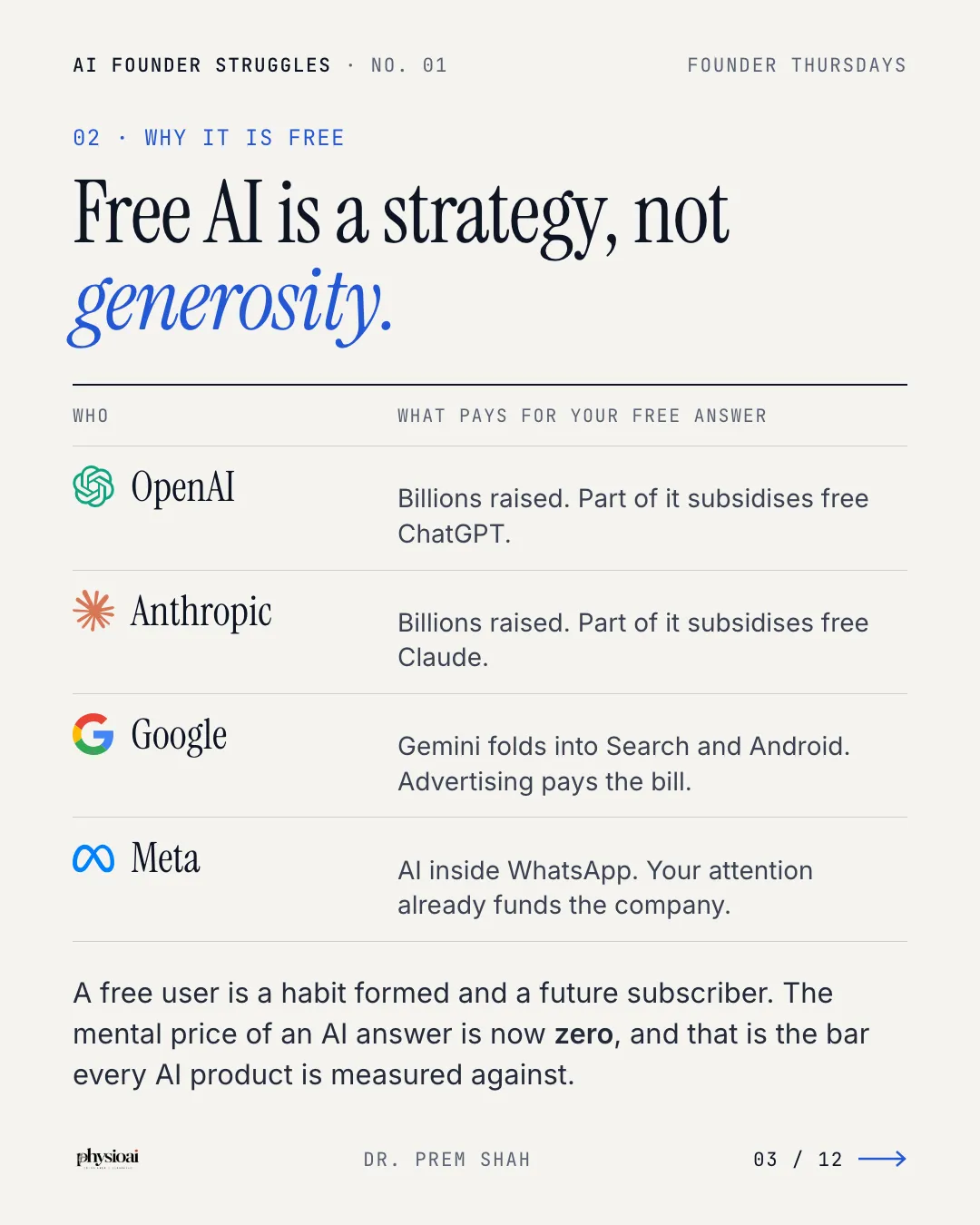
Someone decides to pay for your free answer. OpenAI and Anthropic have raised billions, and part of that money subsidises free ChatGPT and free Claude. Google folds Gemini into Search and Android, and advertising pays the bill. Meta puts its AI inside WhatsApp, where your attention already funds the company.
A free user is a habit formed and a future subscriber. The result is that the mental price of an AI answer is now zero, and that is the bar every AI product is measured against.
Businesses don't get the app. They get the meter.
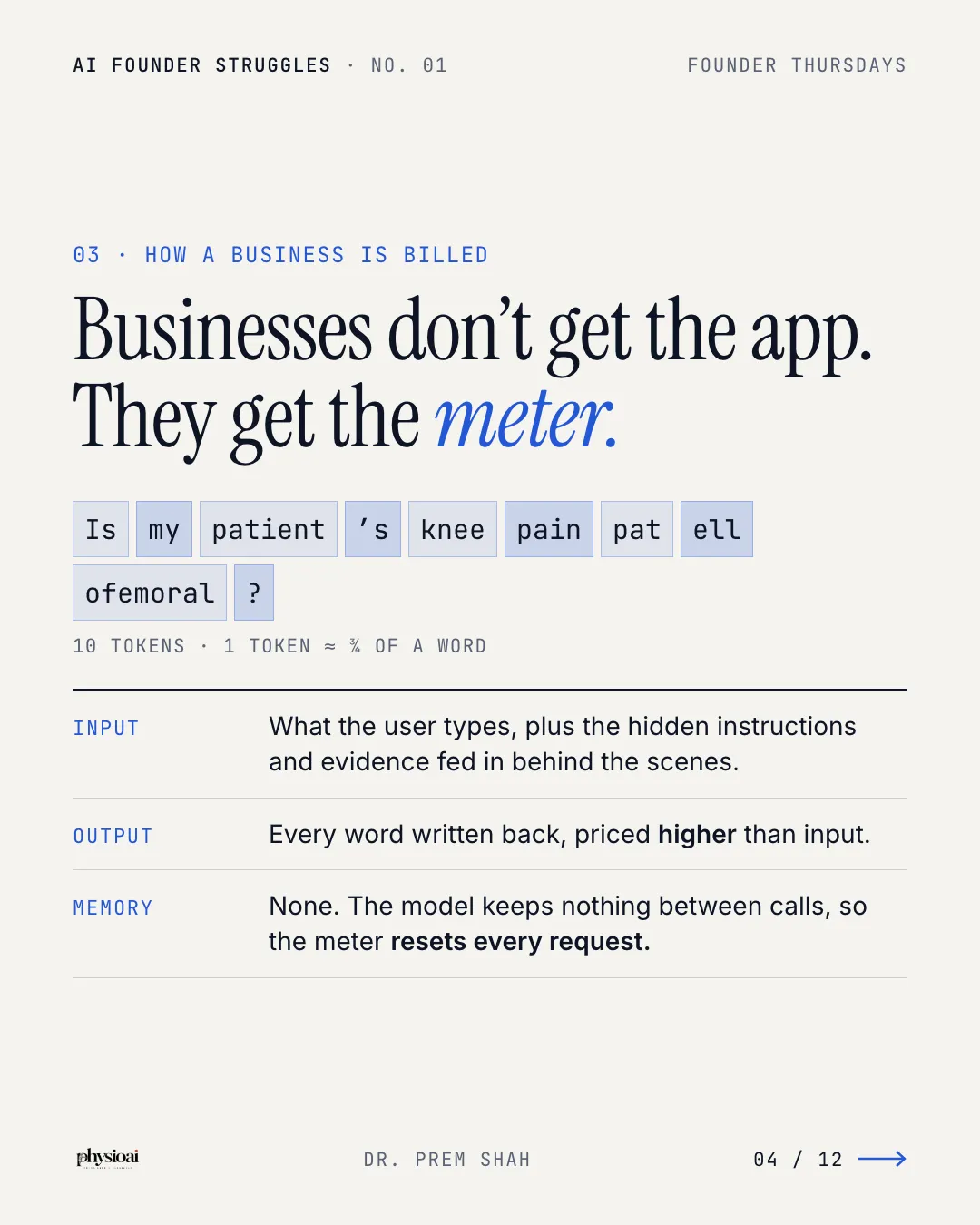
When a product like PhysioAI uses a language model, it is billed in tokens. A token is roughly three quarters of a word. A short question such as "Is my patient's knee pain patellofemoral?" is about ten tokens.
The bill has three parts:
- Input. What the user types, plus the hidden instructions and evidence fed in behind the scenes.
- Output. Every word written back, which is priced higher than input.
- Memory. There is none. The model keeps nothing between calls, so the meter resets on every request.
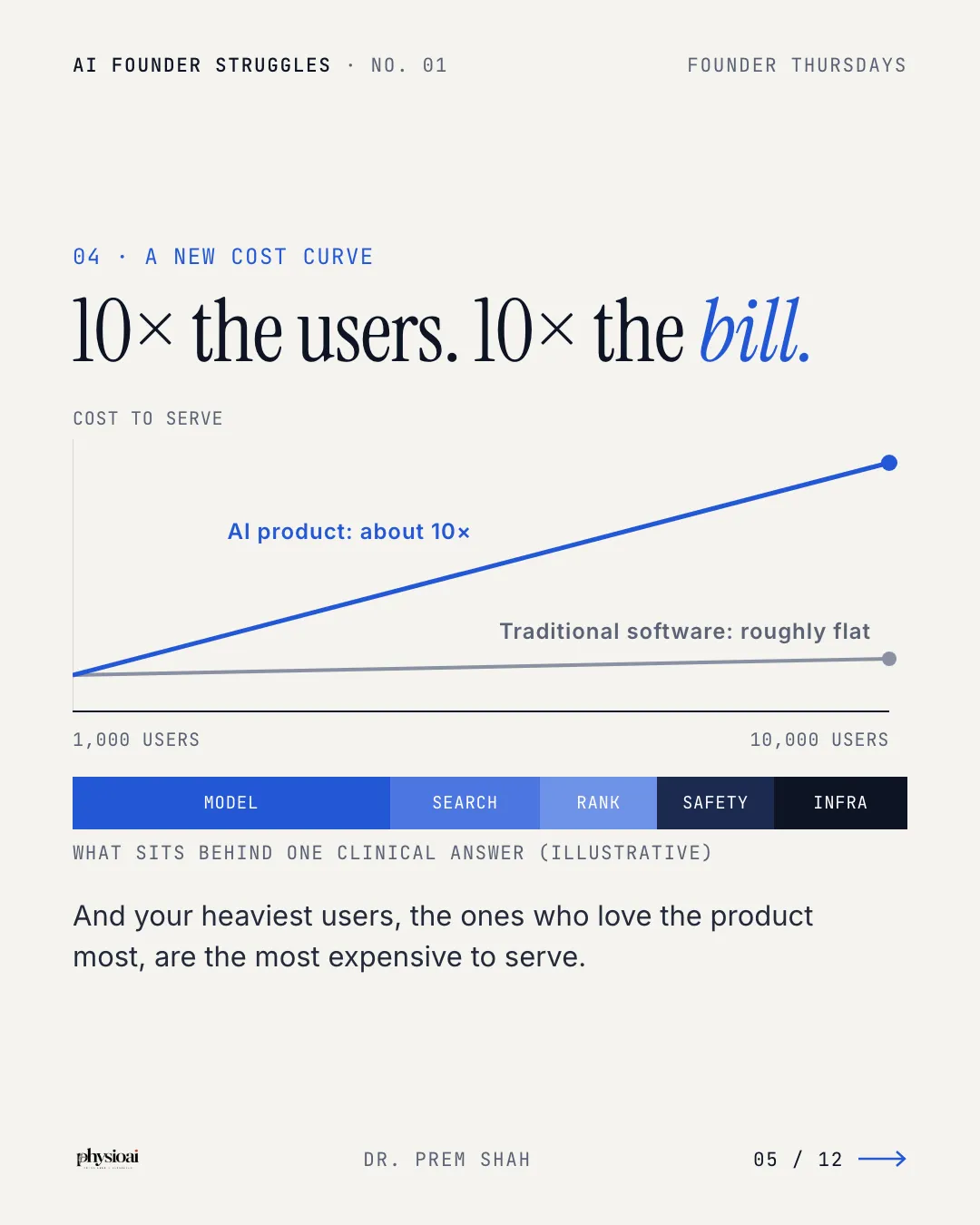
Behind one clinical answer there is more than the model itself: search, ranking, safety checks and infrastructure all add cost. That creates a new kind of cost curve. Ten times the users means ten times the bill, and the heaviest users, the people who love the product most, are the most expensive to serve.
Three trade-offs we keep facing
Price vs wallet
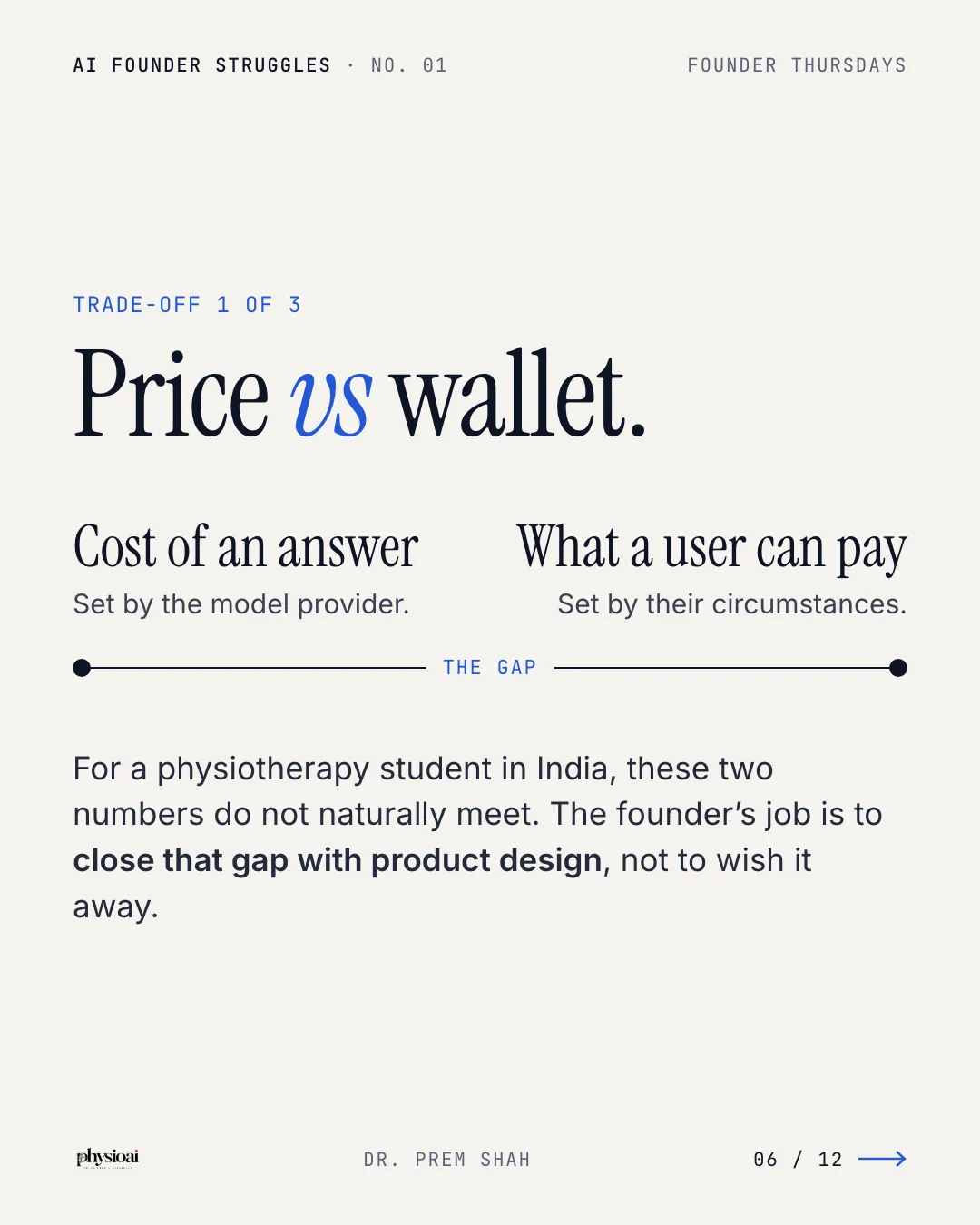
The cost of an answer is set by the model provider. What a user can pay is set by their circumstances. For a physiotherapy student in India, those two numbers do not naturally meet. The founder's job is to close that gap with product design, not to wish it away.
Generosity vs survival
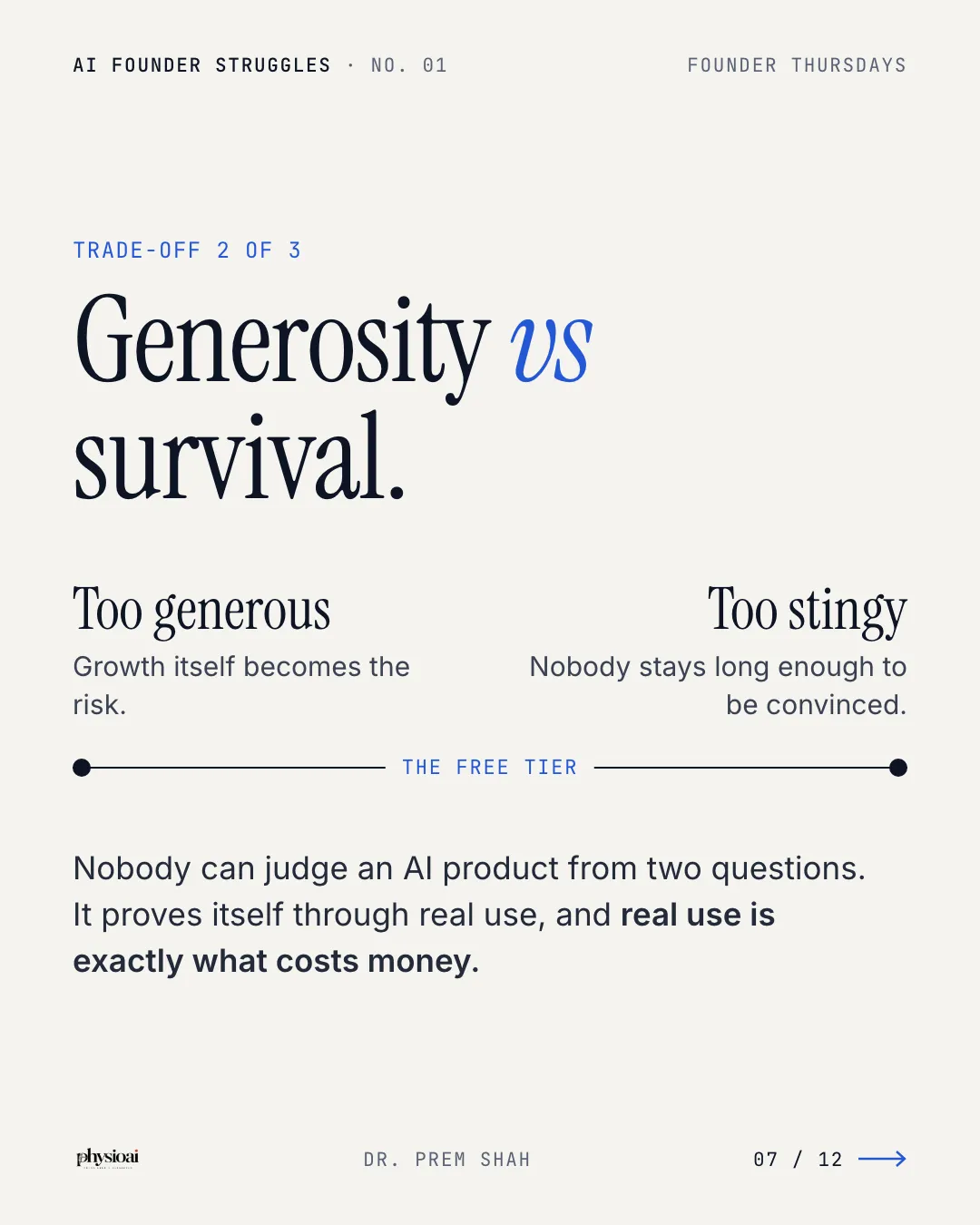
Make the free tier too generous, and growth itself becomes the risk. Make it too stingy, and nobody stays long enough to be convinced. Nobody can judge an AI product from two questions. It proves itself through real use, and real use is exactly what costs money.
Cheaper models vs trust
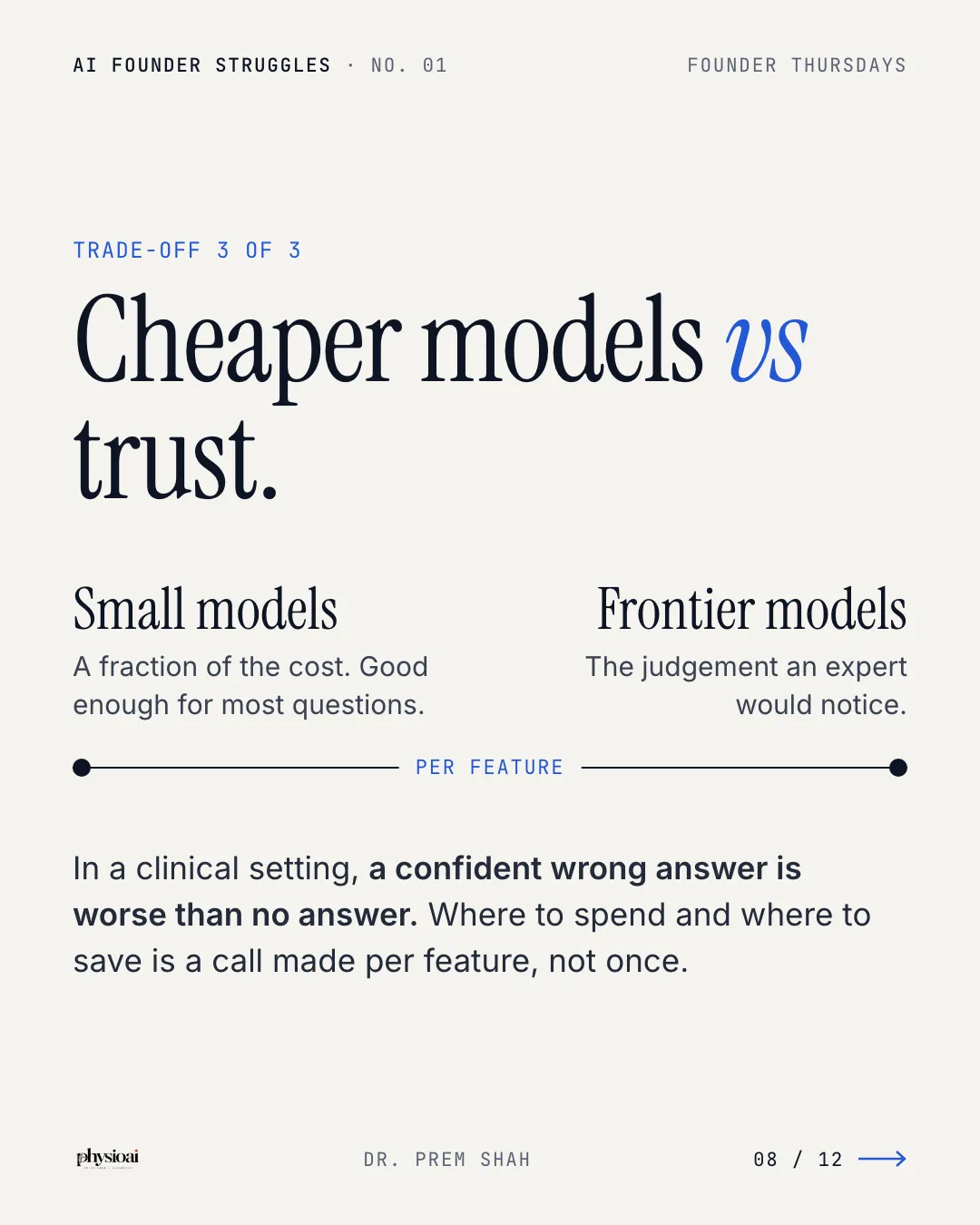
Small models cost a fraction of the price and are good enough for most questions. Frontier models bring the judgement an expert would notice. In a clinical setting, a confident wrong answer is worse than no answer, so where to spend and where to save is a call made per feature, not once for the whole product.
The playbook we would hand any AI founder
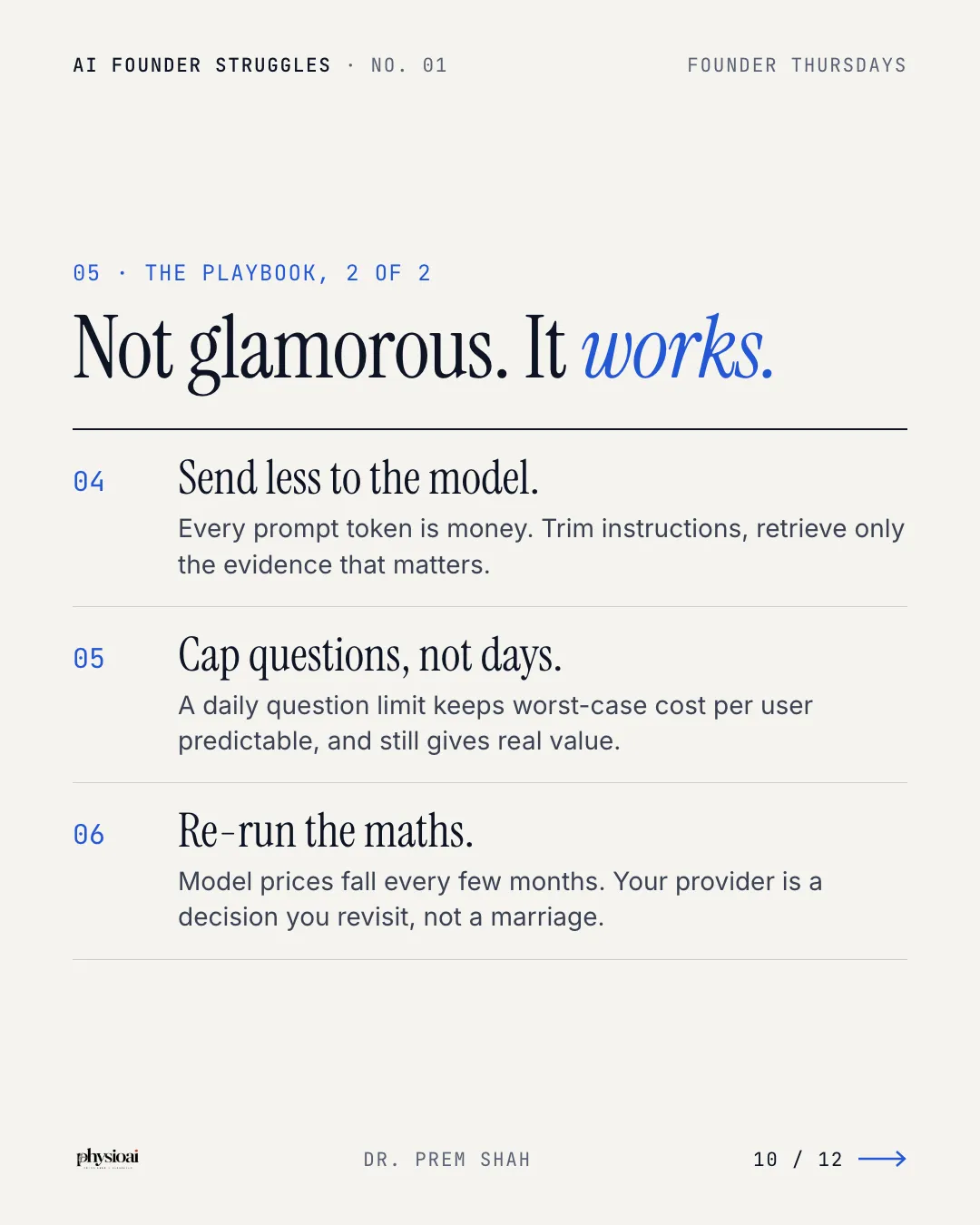
None of this is glamorous. It works.
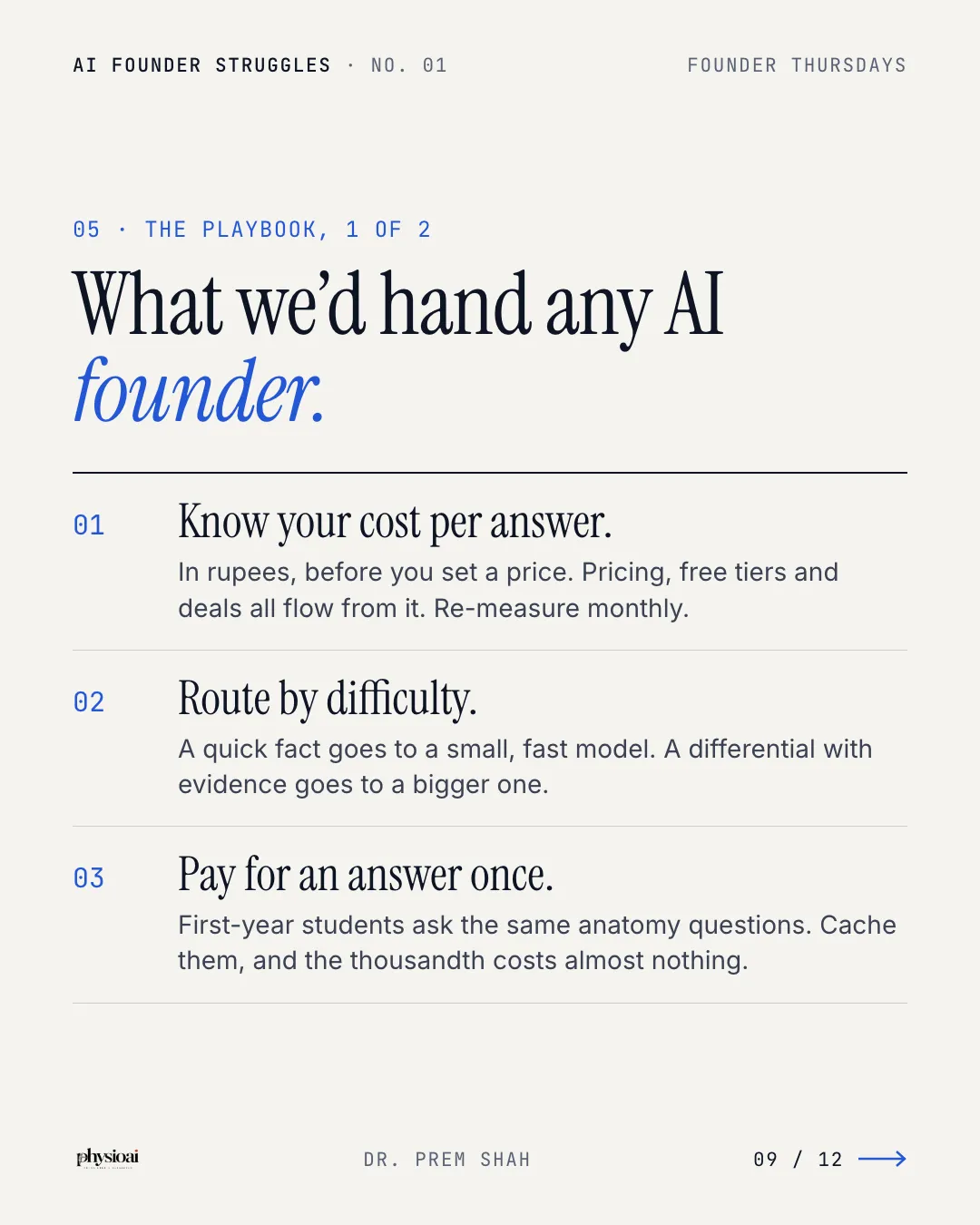
- Know your cost per answer. Measure it in rupees before you set a price. Pricing, free tiers and deals all flow from it. Re-measure monthly.
- Route by difficulty. A quick fact goes to a small, fast model. A differential with evidence goes to a bigger one.
- Pay for an answer once. First-year students ask the same anatomy questions. Cache them, and the thousandth answer costs almost nothing.
- Send less to the model. Every prompt token is money. Trim instructions and retrieve only the evidence that matters.
- Cap questions, not days. A daily question limit keeps the worst-case cost per user predictable and still gives real value.
- Re-run the maths. Model prices fall every few months. Your provider is a decision you revisit, not a marriage.
Together, these are the difference between an AI product that can exist and one that cannot.
What to take away
If you use AI: when a smaller product asks you to pay, it is usually paying too, and doing something the free apps are not built to do.
If you build on AI: your competitor is not the free app. It is the moment a user decides your answer is not worth more than the generic one. Win that moment with depth, judgement and speed.
We are still learning this ourselves, and we will keep sharing what the numbers teach us.
How this shapes PhysioAI's plans
These trade-offs are why PhysioAI's AI plan caps questions per day rather than access by days. Guests and free accounts can ask Synergist, the PhysioAI tutor, a few questions to try it, and Synergist Pro sets a daily allowance of Rapid and Deep Study answers that resets every day. See the current plans and limits on the pricing page.